SB Genus
 04 Aug 2026
The Importance of Backend Development in Modern Web Applications
04 Aug 2026
The Importance of Backend Development in Modern Web Applications


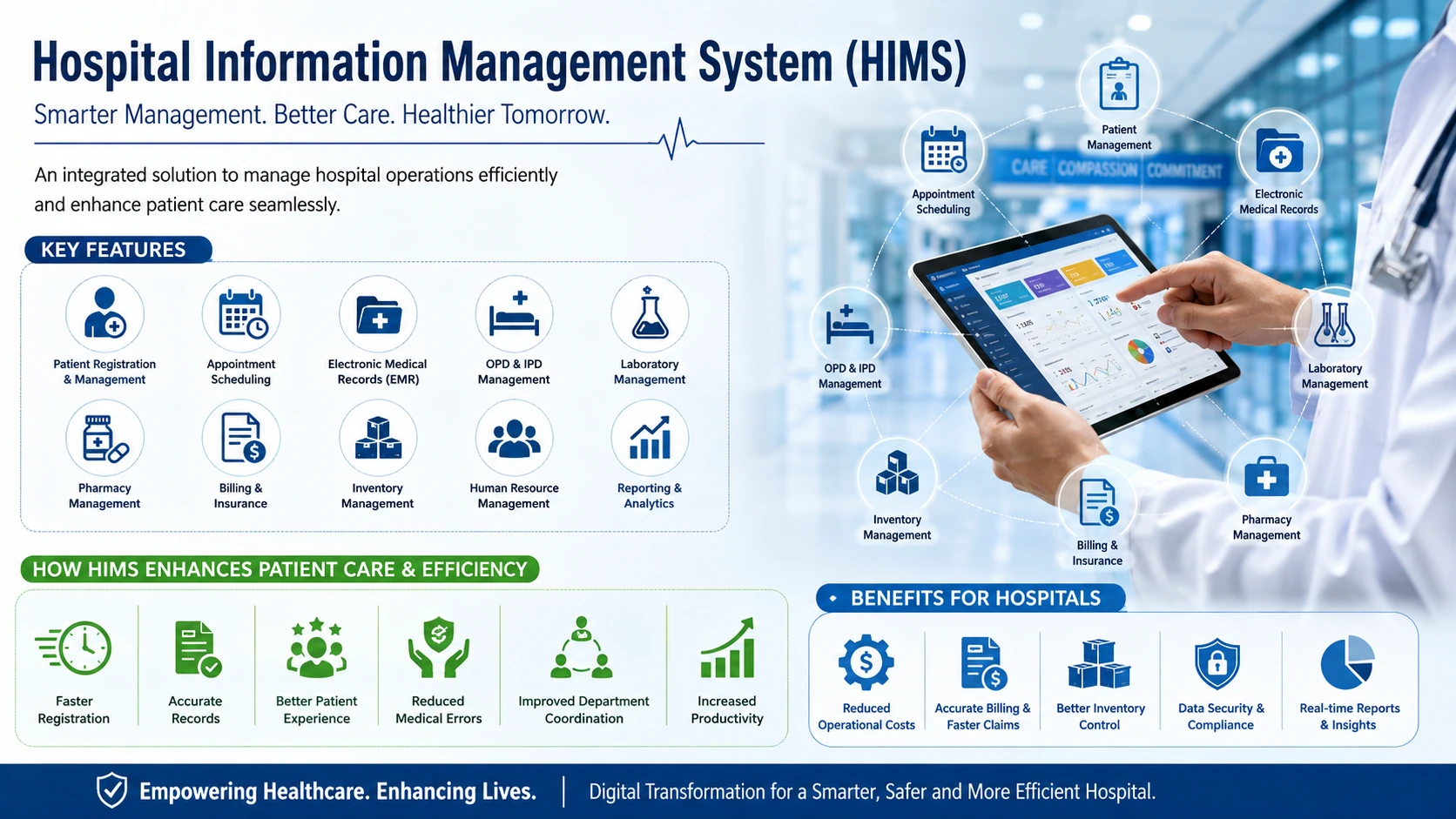
Healthcare is rapidly evolving, and hospitals are increasingly embracing digital transformation to improve patient outcomes and operational excellence. One of the most impactful technologies driving this change is the Hospital Information Management System (HIMS). From patient registration to billing, laboratory management, pharmacy operations, and medical record maintenance, HIMS integrates every critical hospital function into a centralized digital platform.
A well-designed Hospital Information Management System not only simplifies administrative tasks but also enhances the quality of patient care by ensuring accurate, timely, and secure access to healthcare information.
In this comprehensive guide, we'll explore how Hospital Information Management Systems improve patient care, increase hospital efficiency, reduce costs, and prepare healthcare organizations for the future.
A Hospital Information Management System (HIMS) is a comprehensive healthcare software solution designed to streamline and manage the clinical, administrative, financial, and operational activities of hospitals, clinics, nursing homes, and other healthcare organizations. By integrating multiple hospital departments into a single digital platform, HIMS enables healthcare providers to deliver faster, more accurate, and patient-centric services.
Unlike traditional paper-based record management or disconnected software applications, a Hospital Information Management System creates a centralized and secure database where authorized users—including doctors, nurses, administrators, pharmacists, laboratory technicians, and patients—can access real-time medical information anytime, anywhere. This improves communication, reduces manual errors, and enhances the overall quality of healthcare delivery.
A modern Hospital Information Management System typically includes the following modules:
By automating routine tasks and centralizing patient information, HIMS helps healthcare institutions improve operational efficiency, reduce costs, enhance patient safety, and deliver a seamless healthcare experience.
As healthcare facilities continue to grow, hospitals generate massive volumes of patient data every day, including medical histories, diagnostic reports, prescriptions, billing records, insurance details, and treatment plans. Managing this critical information manually can lead to inefficiencies, increased operational costs, and a higher risk of medical errors.
Without a Hospital Information Management System, hospitals often face challenges such as:
A Hospital Information Management System addresses these challenges by automating hospital workflows, digitizing medical records, and providing secure, real-time access to patient information across departments. This ensures smoother coordination between doctors, nurses, laboratories, pharmacies, and administrative staff while minimizing paperwork and reducing operational delays.
By implementing a robust HIMS, hospitals can:
In today's digitally connected healthcare environment, adopting a Hospital Information Management System is no longer a luxury—it's a necessity. Hospitals that invest in HIMS are better equipped to deliver high-quality patient care, improve operational efficiency, and stay competitive in an increasingly technology-driven healthcare industry.
A Hospital Information Management System (HIMS) offers a comprehensive suite of features that help hospitals automate daily operations, improve patient care, and enhance overall healthcare efficiency. By integrating multiple departments into a single digital platform, HIMS simplifies workflows, reduces manual errors, and enables healthcare professionals to deliver faster and more accurate medical services.
A Hospital Information Management System simplifies the patient registration and admission process by creating a unique digital profile for every patient. The system securely stores demographic details, medical history, previous visits, insurance information, and treatment records in one centralized location. This digital approach minimizes paperwork, reduces patient waiting times, and allows healthcare providers to retrieve patient information instantly during future visits.
An integrated appointment scheduling system enables patients to book appointments online while allowing doctors and hospital administrators to manage consultation schedules efficiently. Automated appointment reminders help reduce missed appointments, optimize doctor availability, and improve the overall patient experience.
One of the most valuable features of a Hospital Information Management System is its Electronic Medical Records (EMR) module. It securely stores patient medical histories, diagnoses, prescriptions, allergies, laboratory reports, imaging results, and treatment plans in a centralized database. Doctors can access complete patient information in real time, enabling faster diagnosis, better clinical decisions, and improved continuity of care.
The Pharmacy Management System streamlines medication dispensing by digitally transferring prescriptions from doctors directly to the pharmacy. This minimizes prescription errors caused by illegible handwriting, improves medication tracking, ensures accurate inventory management, and enhances patient safety through timely dispensing of medicines.
The Laboratory Management Module automates the entire diagnostic testing process, from test requests to report generation. Laboratory reports are instantly linked to the patient's electronic medical record, allowing physicians to access diagnostic results in real time. This significantly speeds up diagnosis, improves treatment planning, and reduces reporting delays.
A Hospital Information Management System automates hospital billing, payment processing, and insurance claim management. The system generates accurate invoices, minimizes manual calculation errors, accelerates insurance approvals, and improves revenue cycle management. Automated billing also enhances financial transparency for both hospitals and patients.
The Inventory Management Module helps hospitals efficiently monitor medicines, surgical instruments, medical equipment, and consumable supplies. Real-time inventory tracking prevents stock shortages, reduces wastage, avoids over-purchasing, and ensures that essential medical resources are always available when needed.
An advanced Reporting and Analytics Dashboard provides hospital administrators with real-time insights into patient admissions, revenue, occupancy rates, inventory levels, departmental performance, and staff productivity. These data-driven reports support informed decision-making, operational planning, and continuous improvement in hospital management.
A modern Hospital Information Management System (HIMS) plays a vital role in improving the quality, safety, and efficiency of healthcare services. By digitizing hospital operations and providing instant access to patient information, HIMS enables healthcare professionals to deliver faster, more accurate, and personalized medical care.
Digital patient registration significantly speeds up the admission process by eliminating repetitive paperwork and manual data entry. Patient information is stored securely and can be retrieved instantly during future visits. As a result, hospitals experience shorter waiting times, smoother registration processes, improved patient flow, and a more satisfying healthcare experience.
Key Benefits:
With centralized Electronic Medical Records (EMR), healthcare professionals gain immediate access to a patient's complete medical history, including previous diagnoses, medications, allergies, surgeries, laboratory reports, and imaging results. Having accurate and up-to-date medical information enables doctors to make faster, evidence-based clinical decisions while significantly reducing the risk of treatment errors.
Medical records typically include:
The integration of laboratory, radiology, and pharmacy modules allows physicians to access diagnostic reports as soon as they become available. Real-time access to patient data enables quicker diagnosis, timely treatment decisions, and better coordination among medical teams, ultimately improving patient outcomes.
A Hospital Information Management System connects every department—including Reception, OPD, IPD, Laboratory, Pharmacy, Radiology, Billing, and Administration—through a centralized digital platform. This seamless exchange of information reduces communication gaps, eliminates duplicate data entry, and ensures every department has access to the latest patient information.
Better coordination leads to faster service delivery and more efficient patient care.
Medication errors are one of the most common challenges in healthcare. HIMS significantly improves patient safety by using electronic prescriptions, automated clinical alerts, and standardized treatment workflows.
The system can automatically notify healthcare providers about:
These intelligent alerts help minimize medical errors and improve the quality of patient care.
Because doctors have instant access to comprehensive patient histories, they can develop personalized treatment plans based on each patient's medical condition, previous treatments, allergies, and ongoing medications. Personalized healthcare improves treatment effectiveness, strengthens doctor-patient relationships, and increases patient satisfaction.
In emergency situations, every second matters. A Hospital Information Management System enables emergency physicians to retrieve critical patient information—such as blood group, allergy history, chronic illnesses, current medications, and previous medical records—within seconds. Quick access to accurate medical data supports faster decision-making, reduces treatment delays, and can significantly improve survival rates during medical emergencies.
By ensuring immediate availability of life-saving information, HIMS empowers hospitals to deliver safer, faster, and more effective emergency care.
A Hospital Information Management System (HIMS) plays a crucial role in improving hospital operational efficiency by automating repetitive administrative tasks and streamlining clinical workflows. By replacing manual processes with digital automation, HIMS allows healthcare professionals to spend less time on paperwork and more time delivering high-quality patient care.
Hospitals that implement a Hospital Information Management System experience faster service delivery, better coordination between departments, optimized resource utilization, and increased staff productivity, ultimately leading to improved patient satisfaction and better healthcare outcomes.
The digital patient admission process significantly reduces paperwork and manual data entry, enabling hospitals to admit patients more quickly and efficiently. With instant access to patient records and automated registration workflows, hospitals can reduce waiting times, improve patient flow, and provide a seamless admission experience.
One of the biggest advantages of a Hospital Information Management System is the elimination of paper-based records. Electronic Medical Records (EMR) securely store patient information in a centralized database, reducing the need for physical files and minimizing administrative workload. Digital record management also improves document retrieval, reduces storage costs, and enhances overall operational efficiency.
Doctors, nurses, and administrative staff benefit from instant access to patient records, laboratory reports, prescriptions, and treatment histories. Instead of spending valuable time searching for files, healthcare professionals can focus on patient diagnosis, treatment, and care. Improved workflow automation increases staff productivity and enables hospitals to serve more patients efficiently.
A Hospital Information Management System provides real-time visibility into hospital resources, helping administrators optimize the use of beds, operation theatres, medical equipment, and healthcare staff.
Hospital administrators can efficiently monitor:
Real-time resource management reduces operational bottlenecks, improves scheduling accuracy, and ensures that hospital resources are utilized effectively.
A Hospital Information Management System not only enhances hospital operations but also empowers doctors, nurses, and healthcare professionals by providing the digital tools they need to deliver faster, safer, and more efficient patient care.
By reducing administrative workload and improving access to clinical information, HIMS allows medical staff to focus on what matters most—providing quality healthcare.
Healthcare professionals benefit from:
With automated workflows and centralized patient information, healthcare providers can make informed decisions more quickly, improve treatment accuracy, and enhance the overall patient experience.
Implementing a Hospital Information Management System is not only beneficial for patient care but also for the financial health of healthcare organizations. By automating administrative processes and improving operational efficiency, HIMS helps hospitals reduce costs, increase revenue, and improve overall financial management.
Automation significantly reduces manual labor, paperwork, administrative expenses, and repetitive tasks. Hospitals can streamline operations while lowering operational costs without compromising the quality of healthcare services.
An integrated billing module automatically generates accurate invoices, reducing human errors and preventing revenue leakage. Digital billing also ensures transparency in hospital charges while improving payment collection and financial reporting.
The inventory management system continuously tracks medicines, medical supplies, surgical equipment, and consumables. Real-time inventory monitoring prevents overstocking, reduces wastage, minimizes stock shortages, and helps hospitals optimize procurement costs.
A Hospital Information Management System simplifies insurance claim management by maintaining complete digital patient documentation. Automated claim processing reduces paperwork, speeds up approvals, minimizes claim rejections, and improves cash flow.
By improving operational efficiency, reducing patient waiting times, and optimizing staff productivity, hospitals can accommodate more patients without increasing administrative expenses. Better resource utilization and streamlined workflows contribute directly to higher profitability and sustainable business growth.
Patient health information is one of the most sensitive forms of data, making security a top priority for every healthcare organization. A modern Hospital Information Management System (HIMS) includes advanced security features designed to protect confidential patient records while ensuring compliance with healthcare data protection regulations.
Key security features include:
These advanced security measures help hospitals safeguard patient information, prevent unauthorized access, maintain data integrity, and comply with healthcare privacy regulations. A secure Hospital Information Management System builds patient trust while reducing the risk of data breaches and regulatory penalties.
Although a Hospital Information Management System offers numerous clinical and operational benefits, successful implementation requires careful planning, adequate investment, and effective change management. Understanding these challenges helps healthcare organizations prepare for a smoother digital transformation.
Implementing a Hospital Information Management System requires an initial investment in software, hardware infrastructure, networking, system integration, and staff training. While the upfront cost may be significant, the long-term return on investment is achieved through increased efficiency, reduced operational costs, and improved patient care.
Doctors, nurses, administrative staff, and other healthcare professionals must receive proper training to use the Hospital Information Management System effectively. Comprehensive training programs help employees adapt to the new technology, reduce user errors, and maximize system efficiency.
Migrating patient records from paper files or legacy software systems to a new Hospital Information Management System requires careful planning and data validation. Proper data migration ensures accuracy, maintains data integrity, and prevents information loss during the transition.
Transitioning from traditional manual processes to a digital healthcare environment often requires a cultural shift within the organization. Some employees may initially resist adopting new technology due to unfamiliarity or concerns about workflow changes. Effective leadership, continuous training, and ongoing technical support play a vital role in ensuring successful implementation and long-term adoption.
Despite these initial challenges, the long-term advantages of a Hospital Information Management System—including improved patient care, enhanced operational efficiency, better financial management, and stronger data security—far outweigh the implementation efforts. With a well-planned deployment strategy, hospitals can achieve a successful digital transformation and build a more efficient, patient-centered healthcare system.
A Hospital Information Management System (HIMS) is an integrated healthcare software solution that automates and manages hospital operations, including patient registration, appointment scheduling, electronic medical records (EMR), billing, pharmacy, laboratory, inventory, and administrative tasks. It helps hospitals improve patient care, operational efficiency, and data management.
A Hospital Information Management System improves patient care by providing healthcare professionals with instant access to patient records, reducing medical errors, streamlining communication between departments, enabling faster diagnosis, and supporting personalized treatment plans. It also reduces patient waiting times and enhances the overall healthcare experience.
The key features of a Hospital Information Management System include patient registration, appointment scheduling, Electronic Medical Records (EMR), Electronic Health Records (EHR), pharmacy management, laboratory management, billing and insurance, inventory management, OPD and IPD management, human resource management, and reporting with analytics dashboards.
Implementing a Hospital Information Management System helps hospitals improve operational efficiency, reduce paperwork, enhance patient safety, automate billing, optimize inventory, strengthen communication, increase staff productivity, and provide better healthcare services through digital transformation.
Yes. Modern Hospital Information Management Systems are highly scalable and can be customized for small clinics, nursing homes, diagnostic centers, multispecialty hospitals, and large healthcare organizations. Hospitals can choose modules based on their operational requirements and budget.
Electronic Medical Records (EMR) contain a patient's medical information within a single healthcare facility, while Electronic Health Records (EHR) provide a broader, shareable digital record that can be accessed across multiple healthcare providers. Both are essential components of a modern Hospital Information Management System.
A Hospital Information Management System minimizes medical errors through electronic prescriptions, automated drug interaction alerts, allergy notifications, standardized clinical workflows, and real-time access to accurate patient information. These features help doctors make safer and more informed treatment decisions.
HIMS automates repetitive administrative tasks such as patient registration, billing, appointment scheduling, inventory tracking, and report generation. This reduces manual work, speeds up hospital operations, improves departmental coordination, and increases overall healthcare efficiency.
Yes. Modern Hospital Information Management Systems include advanced security features such as role-based access control, data encryption, multi-factor authentication, automated backups, audit trails, and secure cloud storage to protect sensitive patient information and comply with healthcare data privacy regulations.
Yes. A Hospital Information Management System seamlessly integrates laboratory, radiology, pharmacy, billing, and other hospital departments into a centralized platform. This allows real-time sharing of patient information, faster diagnosis, and more efficient treatment planning.
A Hospital Information Management System automates billing processes by generating accurate invoices, reducing calculation errors, tracking payments, and simplifying insurance claim processing. This improves revenue management while reducing administrative workload.
Some common implementation challenges include the initial investment, staff training, data migration from legacy systems, integration with existing software, and change management. However, proper planning and training can ensure successful implementation and long-term benefits.
Hospital administrators can use HIMS to monitor patient admissions, bed occupancy, staff performance, inventory levels, financial reports, and operational workflows through real-time dashboards. These insights support better decision-making and improve hospital management.
Hospitals should evaluate factors such as scalability, ease of use, customization options, cloud or on-premise deployment, security features, technical support, integration capabilities, regulatory compliance, pricing, and future upgrade options before selecting a Hospital Information Management System.
As healthcare becomes increasingly digital, a Hospital Information Management System is essential for improving patient outcomes, streamlining hospital operations, enhancing data security, supporting telemedicine, integrating Artificial Intelligence (AI), and delivering efficient, patient-centered healthcare services. It enables hospitals to remain competitive while adapting to the future of digital healthcare.
Trusted Clients



.jpg)

.jpg)
.jpg)








SB Genus is a Kolkata-based tech company specializing in custom web development, app development, digital marketing, and startup growth.


© 2017-2026 SB Genus. All rights reserved.