SB Genus
 04 Aug 2026
The Importance of Backend Development in Modern Web Applications
04 Aug 2026
The Importance of Backend Development in Modern Web Applications


The software development industry has undergone a remarkable transformation over the past decade. Businesses of every size are increasingly relying on digital platforms to reach customers, streamline operations, and remain competitive in a rapidly evolving market. Websites and web applications have become essential business assets, serving as customer touchpoints, sales channels, and productivity tools. As user expectations continue to rise, developers are expected to build applications that are fast, secure, scalable, and easy to maintain.
Meeting these expectations using traditional coding methods has become increasingly difficult. Writing every feature from scratch not only consumes valuable development time but also increases the likelihood of errors and security vulnerabilities. This challenge has led to the widespread adoption of web development frameworks, which provide developers with structured environments, reusable components, and standardized development practices.
Web development frameworks have become the backbone of modern software development by enabling faster project delivery, improving code quality, and simplifying the creation of complex applications. Whether it is a startup launching a new product or an enterprise managing large-scale digital platforms, frameworks play a crucial role in ensuring efficiency and consistency throughout the development process.
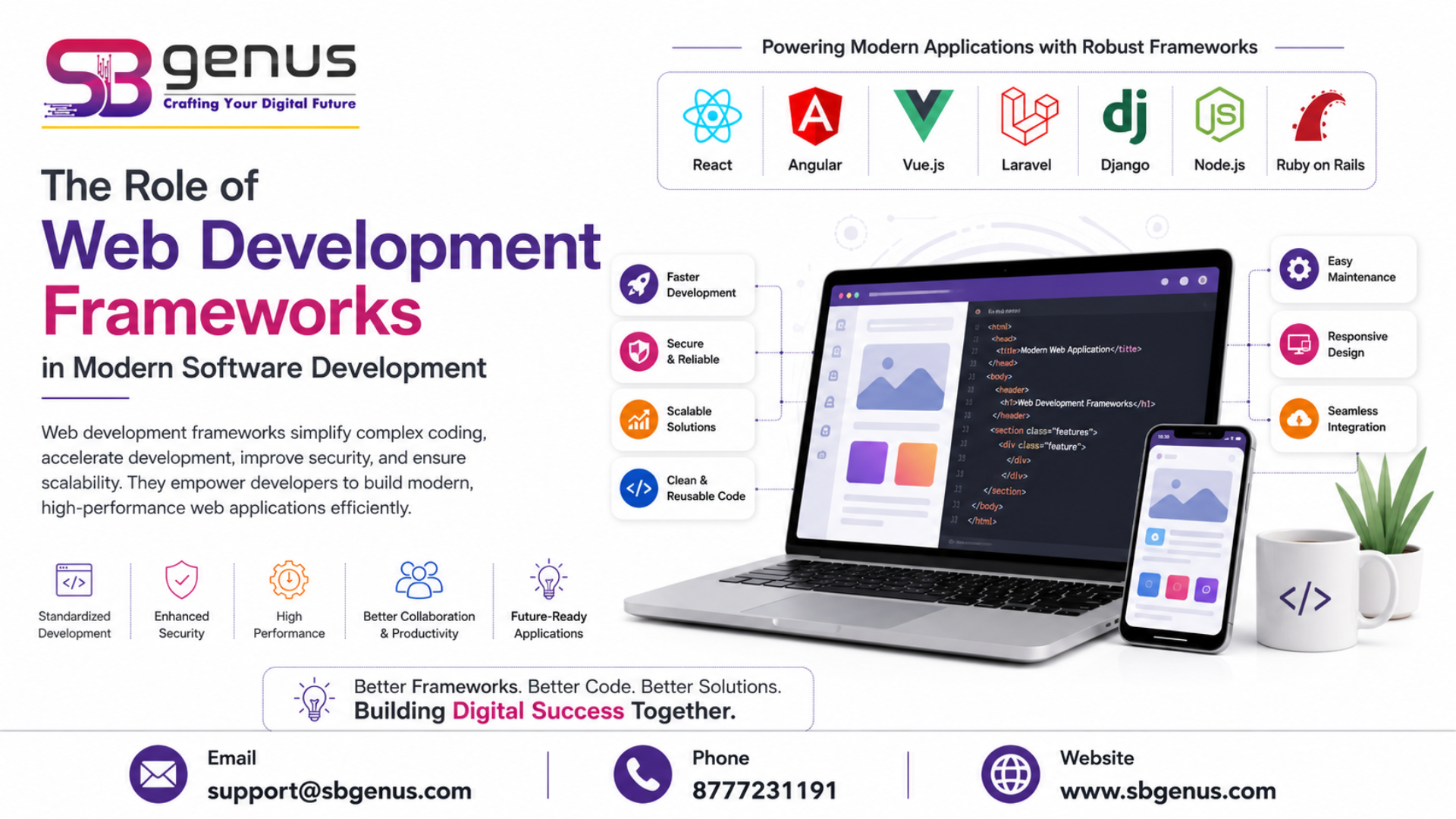
A web development framework is a collection of pre-written code, libraries, tools, and conventions that simplify the process of building web applications. Instead of developing every component from the ground up, developers can rely on a framework to handle common functionalities such as routing, authentication, database interaction, session management, security, and API integration.
Frameworks establish a structured approach to development by encouraging coding standards and architectural patterns. Most modern frameworks follow the Model-View-Controller (MVC) architecture or similar design principles that separate business logic, user interfaces, and data management into distinct layers. This separation makes applications easier to understand, test, and maintain.
Rather than replacing programming knowledge, frameworks enhance developer productivity by allowing them to focus on solving business problems instead of repeatedly implementing standard features.
Modern software development demands speed, reliability, security, and scalability. Businesses often operate in highly competitive environments where reducing development time can directly influence market success. Web development frameworks address these challenges by offering proven solutions that have been tested by millions of developers worldwide.
One of the primary reasons frameworks are indispensable is their ability to accelerate development. Since common functionalities are already included within the framework, developers spend less time writing repetitive code and more time building features that deliver value to users. This results in shorter development cycles and faster product launches.
Frameworks also improve collaboration within development teams. When developers follow the same coding standards and project structures, onboarding new team members becomes easier, and maintaining large applications becomes significantly more manageable. Consistency across the codebase reduces confusion and minimizes technical debt over time.
Security is another major factor driving framework adoption. Modern cyber threats continue to evolve, making security a top priority for every software project. Established frameworks include built-in protections against common vulnerabilities such as SQL injection, Cross-Site Scripting (XSS), Cross-Site Request Forgery (CSRF), and session hijacking. These security mechanisms help developers create safer applications without implementing every protection manually.
Furthermore, frameworks make software more adaptable to changing business requirements. As applications grow in complexity and user traffic increases, frameworks provide scalable architectures that support future expansion without requiring complete redevelopment.
Web development frameworks are generally divided into frontend frameworks and backend frameworks, each serving a different purpose within an application.
Frontend frameworks focus on the user interface and user experience. They manage how information is displayed and how users interact with the application. These frameworks make it easier to build responsive, dynamic, and interactive interfaces while maintaining high performance across various devices.
Backend frameworks handle the server-side operations of a web application. They manage databases, business logic, authentication systems, APIs, server communication, and data processing. Backend frameworks ensure that applications remain secure, efficient, and capable of handling multiple users simultaneously.
Many modern applications combine both frontend and backend frameworks to create full-stack solutions capable of delivering seamless user experiences.
The growing popularity of web development frameworks can be attributed to the numerous advantages they offer throughout the software development lifecycle.
Development speed is perhaps the most obvious benefit. Frameworks provide ready-to-use modules, reducing repetitive coding tasks and enabling developers to complete projects more efficiently. Businesses benefit from shorter development timelines, allowing them to introduce products to the market faster.
Code quality also improves significantly when frameworks are used. Their structured architecture encourages clean coding practices, modular design, and standardized project organization. Well-structured code is easier to debug, test, and extend, reducing long-term maintenance costs.
Scalability is another major advantage. As businesses expand and user demand grows, applications often require additional features, higher traffic capacity, and more complex integrations. Frameworks are designed with scalability in mind, making it easier to enhance existing systems without disrupting core functionality.
Maintenance becomes considerably simpler because frameworks organize code into predictable structures. Developers can quickly identify issues, implement updates, and introduce new features without affecting unrelated parts of the application.
Testing is also streamlined through framework support. Many frameworks include integrated testing tools or support automated testing methodologies, allowing developers to identify bugs early in the development process and deliver more reliable software.
Performance optimisation is another important benefit. Modern frameworks include advanced rendering techniques, caching mechanisms, efficient routing systems, and database optimisation tools that contribute to faster page loading times and improved user experiences.
Frameworks also simplify third-party integrations. Whether connecting payment gateways, cloud storage services, social media platforms, analytics tools, or artificial intelligence APIs, modern frameworks provide built-in support for seamless integration with external services.
The web development ecosystem continues to evolve, with several frameworks maintaining strong positions due to their performance, flexibility, and active communities.
React remains one of the most widely used frontend technologies for developing highly interactive single-page applications. Its component-based architecture promotes code reusability and simplifies the management of complex user interfaces.
Angular continues to serve enterprise-level projects requiring comprehensive development solutions. Its built-in features for dependency injection, routing, form validation, and state management make it suitable for large-scale applications.
Vue.js has gained widespread popularity because of its simplicity and ease of learning while still offering powerful capabilities for building modern interfaces.
On the backend, Laravel remains one of the preferred PHP frameworks due to its elegant syntax, extensive ecosystem, built-in authentication, and robust security features. It is particularly popular for content management systems, business portals, and e-commerce applications.
Django continues to be a leading Python framework, especially for data-driven applications and projects involving artificial intelligence, machine learning, and scientific computing. Its emphasis on rapid development and security has made it a trusted choice across industries.
Node.js frameworks such as Express.js and NestJS are widely used for creating fast, scalable APIs and real-time applications. Their event-driven architecture makes them ideal for chat systems, streaming platforms, and collaborative applications.
Ruby on Rails remains recognised for rapid application development and convention-over-configuration principles, enabling developers to build reliable web applications efficiently.
The continued evolution of these frameworks demonstrates the industry's commitment to improving developer productivity while meeting modern software requirements.
Although web development frameworks provide numerous benefits, selecting the appropriate framework requires careful evaluation. Every project has unique technical requirements, business objectives, scalability expectations, and team expertise.
One challenge is the learning curve associated with advanced frameworks. Developers must invest time in understanding framework architecture, best practices, and ecosystem tools before becoming fully productive.
Dependency management is another consideration. Frameworks often rely on multiple third-party packages, requiring regular updates to maintain compatibility and security. Failure to keep dependencies updated may expose applications to vulnerabilities or compatibility issues.
Performance can also be affected if frameworks are used without proper optimisation. Choosing a framework with unnecessary complexity for a relatively simple application may increase resource consumption and maintenance effort.
Framework popularity and community support should also influence decision-making. Frameworks backed by active communities typically receive regular updates, improved documentation, bug fixes, and long-term support, reducing development risks.
Ultimately, selecting the right framework involves balancing project requirements, development resources, future scalability, and long-term maintainability.
The future of web development frameworks is closely tied to emerging technologies such as artificial intelligence, cloud computing, serverless architecture, edge computing, and WebAssembly. Frameworks are increasingly incorporating intelligent development tools, automated code generation, performance optimisation, and AI-assisted debugging capabilities.
Progressive Web Applications (PWAs) continue to blur the distinction between traditional websites and mobile applications. Modern frameworks now provide built-in support for offline functionality, push notifications, responsive interfaces, and app-like experiences.
Microservices architecture is also influencing framework development. Rather than building monolithic applications, developers increasingly create modular services that communicate through APIs. Frameworks are adapting by offering better support for distributed systems and cloud-native deployments.
As cybersecurity concerns continue to grow, future frameworks will place even greater emphasis on built-in security features, automated vulnerability detection, and compliance with international data protection regulations.
Artificial intelligence is expected to further transform development workflows by assisting with code completion, testing, optimisation, and application monitoring. Frameworks that effectively integrate AI-powered tools are likely to define the next generation of software development.
Web development frameworks have fundamentally transformed modern software development by providing structured, efficient, and secure environments for building web applications. They enable developers to accelerate development, improve code quality, strengthen security, simplify maintenance, and create scalable solutions capable of supporting evolving business needs.
As digital transformation continues across industries, the demand for high-quality web applications will only increase. Organisations that embrace modern frameworks gain a competitive advantage through faster development cycles, improved software reliability, and enhanced user experiences. While selecting the right framework requires careful consideration of project requirements and technical expertise, the long-term benefits significantly outweigh the initial learning investment.
The future of software development will continue to be shaped by increasingly intelligent frameworks that integrate artificial intelligence, cloud-native technologies, automation, and enhanced security practices. For developers and businesses alike, understanding and effectively utilising web development frameworks has become an essential component of building successful digital products in today's technology-driven world.
A web development framework is a software platform that provides reusable code, libraries, tools, and development standards to simplify the creation of websites and web applications while improving efficiency, security, and maintainability.
Web development frameworks reduce development time, improve code consistency, enhance application security, simplify maintenance, and make software easier to scale as business requirements evolve.
Frontend frameworks focus on creating user interfaces and enhancing user interactions, whereas backend frameworks manage server-side operations, databases, authentication, APIs, and business logic.
The ideal framework depends on the programming language and project goals. Laravel is an excellent choice for PHP developers, Django is beginner-friendly for Python developers, while Vue.js is often recommended for those starting frontend development because of its simplicity.
Most modern frameworks include built-in security features that help protect applications against common cyber threats such as SQL injection, Cross-Site Scripting (XSS), Cross-Site Request Forgery (CSRF), and authentication vulnerabilities. However, developers must still follow security best practices and regularly update framework dependencies.
Frameworks promote organised project structures, reusable components, automated testing, coding standards, and efficient debugging, all of which contribute to more reliable, maintainable, and scalable software.
Yes. Small businesses benefit from faster development, reduced costs, easier maintenance, improved security, and the ability to expand their applications as their operations grow without requiring complete redevelopment.
The future of web development frameworks includes deeper integration with artificial intelligence, cloud computing, serverless technologies, Progressive Web Applications, enhanced security mechanisms, automated testing, and intelligent development environments that further improve productivity and software quality.
Trusted Clients



.jpg)


.jpg)
.jpg)








SB Genus is a Kolkata-based tech company specializing in custom web development, app development, digital marketing, and startup growth.


© 2017-2026 SB Genus. All rights reserved.