SB Genus
 04 Aug 2026
The Importance of Backend Development in Modern Web Applications
04 Aug 2026
The Importance of Backend Development in Modern Web Applications


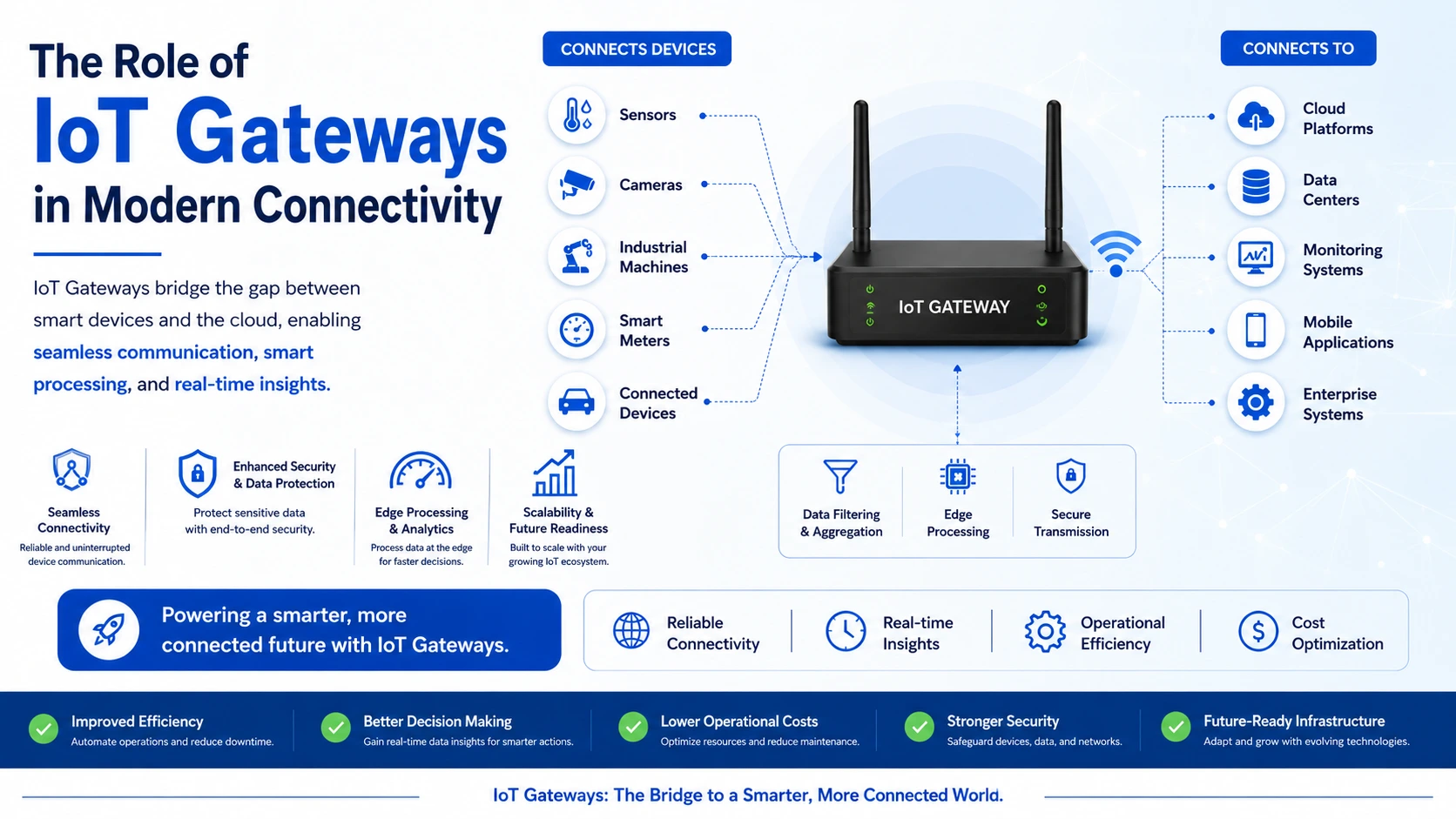
The Internet of Things (IoT) has transformed how devices communicate, collect data, and automate everyday tasks. From smart homes and healthcare systems to industrial automation and connected vehicles, billions of IoT devices are continuously exchanging information. However, these devices often use different communication protocols and generate enormous volumes of data. This is where IoT gateways play a crucial role.
An IoT gateway acts as an intelligent bridge between IoT devices, edge networks, and cloud platforms. It ensures seamless communication, improves security, filters data, and enables real-time decision-making. As organisations continue to adopt connected technologies, IoT gateways have become a fundamental component of modern connectivity.
In this article, we'll explore the role of IoT gateways, their functions, benefits, applications, challenges, and future trends.
An IoT gateway is a hardware or software solution that serves as the communication bridge between IoT devices, cloud platforms, enterprise applications, and local data centers. It collects data from connected sensors and smart devices, processes and filters that data locally, and securely transmits relevant information to the cloud for further analysis and storage.
Rather than allowing every IoT device to connect directly to cloud services, an Internet of Things (IoT) gateway manages communication efficiently. This reduces network traffic, minimizes latency, enhances data security, and improves the overall performance of an IoT ecosystem. By enabling local data processing through edge computing, IoT gateways also support faster decision-making and reduce bandwidth consumption.
One of the biggest advantages of an IoT gateway is its ability to support multiple communication protocols, allowing devices from different manufacturers to work together seamlessly. Common protocols supported by IoT gateways include:
By supporting these communication standards, an IoT gateway ensures seamless interoperability between diverse IoT devices, enabling organizations to build scalable, secure, and highly efficient connected ecosystems.
Understanding how IoT gateways work is essential to recognizing their role in modern IoT ecosystems. An IoT gateway acts as an intelligent intermediary that enables seamless communication between IoT devices, edge networks, and cloud platforms. It not only transfers data but also processes, secures, and manages information before it reaches its destination, ensuring efficient and reliable IoT connectivity.
The first step in the IoT communication process is data collection. Connected sensors and IoT devices continuously gather real-time information such as temperature, humidity, pressure, location, motion, energy consumption, and machine performance. The IoT gateway receives this data from multiple devices and prepares it for further processing.
Instead of sending massive amounts of raw data directly to cloud servers, the IoT gateway performs edge computing by processing and analyzing the data locally. It filters duplicate or unnecessary information, aggregates relevant data, and performs initial analytics. This reduces network bandwidth, lowers cloud computing costs, and enables faster real-time decision-making.
IoT devices often communicate using different networking protocols, making interoperability a challenge. An IoT gateway solves this issue by translating communication protocols such as MQTT, Modbus, Zigbee, Bluetooth, LoRaWAN, and OPC-UA into a standardized format. This ensures seamless communication between devices, applications, and cloud platforms, regardless of the manufacturer or communication standard.
Once the data has been processed and validated, the IoT gateway securely transmits only the relevant information to cloud platforms or enterprise applications. Advanced security features such as data encryption, authentication, secure communication protocols, and firewall protection safeguard sensitive information from cyber threats and unauthorized access during transmission.
Beyond data communication, an IoT gateway also simplifies device management. It enables administrators to remotely monitor connected IoT devices, deploy firmware updates, configure network settings, diagnose faults, and troubleshoot issues without requiring physical access. This centralized management improves operational efficiency, reduces maintenance costs, and ensures that IoT networks remain secure and up to date.
By combining data collection, edge computing, protocol translation, secure communication, and remote device management, an IoT gateway serves as the backbone of modern IoT connectivity, enabling organizations to build scalable, secure, and high-performance connected ecosystems.
An IoT gateway is much more than a communication bridge—it is the central hub that enables secure, reliable, and efficient connectivity within an IoT ecosystem. By handling data processing, protocol conversion, security, and device management, an Internet of Things (IoT) gateway ensures seamless communication between connected devices and cloud platforms. Below are the key functions that make IoT gateways an essential component of modern connectivity.
One of the primary functions of an IoT gateway is protocol conversion. IoT devices often use different communication standards, making direct communication difficult. An IoT gateway translates protocols such as MQTT, Modbus, Zigbee, Bluetooth, LoRaWAN, OPC-UA, and Wi-Fi, allowing devices from different manufacturers to communicate seamlessly. This eliminates compatibility issues and creates a unified, scalable IoT ecosystem.
Modern IoT gateways support edge computing, enabling data processing closer to the source rather than relying entirely on cloud servers. By analyzing and filtering data locally, the gateway reduces latency, minimizes bandwidth consumption, and enables real-time decision-making. This is especially beneficial for industries such as manufacturing, healthcare, and smart cities, where rapid responses are critical.
Benefits of Edge Computing include:
An IoT gateway intelligently filters, aggregates, and processes incoming data before sending it to cloud platforms. Instead of transmitting every piece of raw sensor data, the gateway identifies meaningful information and forwards only relevant insights. This reduces unnecessary network traffic, optimizes cloud resources, and improves overall system efficiency.
For example: Instead of sending temperature readings every second, an IoT gateway can be configured to transmit data only when the temperature exceeds predefined thresholds or when unusual patterns are detected. This ensures faster alerts while reducing data transmission costs.
Security is one of the most critical functions of an IoT gateway. Since all device communication passes through the gateway, it acts as the first line of defense against cyber threats. Modern IoT gateways implement multiple security mechanisms to protect connected devices, sensitive data, and enterprise networks.
Key security features include:
These advanced security features help prevent unauthorized access, data breaches, malware attacks, and other cybersecurity risks within IoT networks.
An IoT gateway also simplifies device management by providing centralized control over connected IoT devices. IT administrators and system operators can remotely monitor device health, configure settings, deploy firmware updates, troubleshoot issues, and manage network performance without requiring on-site maintenance.
Common device management capabilities include:
By enabling centralized management, IoT gateways reduce operational costs, improve system reliability, and ensure that connected devices remain secure, updated, and operating at peak performance.
As the number of connected devices continues to grow, businesses need efficient solutions to manage data, security, and communication. An IoT gateway plays a vital role in improving connectivity, enhancing performance, and enabling seamless communication between IoT devices, edge networks, and cloud platforms. By combining edge computing, data processing, and advanced security features, IoT gateways offer numerous benefits across industries.
One of the biggest advantages of an IoT gateway is its ability to improve network efficiency. Instead of sending all raw sensor data directly to the cloud, the gateway processes and filters information locally. This significantly reduces network congestion and ensures that only relevant and actionable data is transmitted.
As a result, organizations can:
By streamlining data communication, IoT gateways help organizations build faster and more efficient IoT ecosystems.
Modern IoT gateways leverage edge computing to process and analyze data closer to the source. This eliminates the delays associated with sending data to distant cloud servers and waiting for responses.
Real-time data processing enables businesses to make faster and more informed decisions, especially in industries where immediate action is critical.
Key advantages include:
Industries such as manufacturing, healthcare, transportation, and smart cities benefit greatly from the low-latency capabilities of IoT gateways.
Security is a major concern in connected environments, and an IoT gateway acts as a critical security layer within the IoT infrastructure. Since all device communication passes through the gateway, it can monitor, filter, and secure data before it reaches cloud platforms or enterprise systems.
Advanced IoT security features include:
These security measures help protect sensitive data, prevent unauthorized access, and reduce the risk of cyberattacks targeting IoT networks.
An IoT gateway helps organizations reduce operational expenses by minimizing cloud computing workloads and optimizing data transmission. Since only essential data is sent to cloud platforms, businesses can significantly lower bandwidth and storage costs.
Additional cost-saving benefits include:
By optimizing resource consumption, IoT gateways deliver a higher return on investment (ROI) for IoT deployments.
As businesses expand their IoT infrastructure, managing thousands of connected devices can become challenging. An IoT gateway simplifies scalability by providing centralized communication and device management.
Organizations can easily:
This scalability makes IoT gateways an ideal solution for enterprises planning long-term digital transformation initiatives.
Reliable communication is essential for mission-critical IoT applications. Many IoT gateways can continue processing and storing data locally even when internet connectivity is temporarily unavailable.
Once the connection is restored, the gateway automatically synchronizes the stored data with cloud platforms, ensuring no critical information is lost.
Benefits of enhanced reliability include:
This capability is particularly valuable for industries such as manufacturing, healthcare, logistics, and energy management, where system interruptions can lead to significant operational and financial losses.
Overall, the benefits of IoT gateways in modern connectivity extend far beyond simple device communication. By improving network efficiency, enabling edge computing, enhancing security, reducing costs, supporting scalability, and ensuring reliability, IoT gateways serve as a cornerstone of successful and future-ready IoT ecosystems.
The versatility of IoT gateways has made them a critical component across a wide range of industries. By enabling seamless communication between connected devices, cloud platforms, and enterprise systems, IoT gateways help organizations improve efficiency, enhance security, and make data-driven decisions. From industrial automation and healthcare to smart cities and smart homes, IoT gateways are transforming the way businesses and communities operate.
In the manufacturing sector, Industrial IoT (IIoT) gateways play a crucial role in connecting machinery, sensors, robotics, and production systems. These gateways collect and process real-time operational data, enabling manufacturers to optimize performance and improve productivity.
Key benefits of IoT gateways in manufacturing include:
By enabling real-time analytics and automation, IoT gateways help manufacturers build smarter, more efficient factories.
As urban populations continue to grow, municipalities are adopting IoT gateway solutions to create smarter and more sustainable cities. IoT gateways connect various city infrastructure systems, allowing local governments to monitor and manage resources more effectively.
Common smart city applications include:
These smart city initiatives improve urban efficiency, reduce operational expenses, and enhance the quality of life for residents.
The healthcare industry increasingly relies on IoT gateways to support connected medical devices and ensure secure data transmission. By connecting healthcare equipment, wearable devices, and hospital management systems, IoT gateways enable real-time patient monitoring and improved healthcare delivery.
Popular healthcare IoT applications include:
With secure and reliable connectivity, healthcare providers can access real-time patient data while maintaining regulatory compliance and improving patient outcomes.
Modern agriculture is undergoing a digital transformation with the help of IoT gateways and smart farming technologies. These gateways connect agricultural sensors and monitoring devices, allowing farmers to collect and analyze critical environmental data.
IoT applications in agriculture include:
By leveraging real-time insights, farmers can improve crop yields, conserve water resources, reduce operational costs, and make more informed agricultural decisions.
The transportation and logistics industry uses IoT gateways to improve fleet management, supply chain visibility, and operational efficiency. By collecting and processing data from connected vehicles and tracking systems, IoT gateways provide businesses with valuable real-time insights.
Key transportation and logistics applications include:
These capabilities help logistics providers reduce costs, improve delivery performance, and enhance overall supply chain management.
In the growing smart home market, IoT gateways serve as the central hub that connects and manages various smart devices within a home environment. They enable seamless communication between devices and allow users to control multiple systems through a single interface.
Common smart home devices connected through IoT gateways include:
With centralized device management and automation capabilities, homeowners can enjoy greater convenience, enhanced security, improved energy efficiency, and a more connected living experience.
As IoT adoption continues to expand, the applications of IoT gateways across industries will become even more diverse. Their ability to enable secure communication, real-time data processing, and seamless device integration makes them an essential technology for building intelligent, scalable, and future-ready connected ecosystems.
While IoT gateways offer numerous benefits, including enhanced connectivity, edge computing, and improved security, they also present several challenges that organizations must address to ensure successful IoT deployment. Understanding these challenges can help businesses implement more reliable, scalable, and secure IoT infrastructures.
Although an IoT gateway serves as a critical security layer within an IoT ecosystem, it can also become a potential target for cyberattacks if not properly managed. Since gateways act as the central communication point between IoT devices and cloud platforms, any security vulnerability can expose the entire network to risks such as unauthorized access, data breaches, malware infections, and ransomware attacks.
To strengthen IoT security, organizations should implement:
A proactive cybersecurity strategy is essential for protecting connected devices and sensitive business data.
As businesses expand their IoT networks, managing a growing number of connected devices can become increasingly complex. Large-scale IoT deployments may involve thousands of sensors, machines, and smart devices that continuously generate data.
To maintain optimal performance, IoT gateways must be capable of:
Organizations must carefully select scalable IoT gateway solutions that can accommodate future growth and evolving business requirements.
One of the most common challenges in IoT implementation is integrating modern IoT gateways with existing legacy systems and industrial equipment. Many older devices were not designed to support today's advanced communication protocols, making interoperability a significant concern.
Organizations often face challenges such as:
Proper planning and the use of gateways with advanced protocol translation capabilities can help overcome these integration obstacles.
Maintaining an IoT gateway infrastructure requires continuous monitoring and management to ensure long-term performance, reliability, and security. As IoT environments grow, maintenance requirements can also increase significantly.
Organizations must regularly:
While these maintenance activities involve additional costs and resources, they are essential for ensuring uninterrupted operations and maximizing the lifespan of IoT infrastructure.
Despite these challenges, businesses that invest in proper planning, robust security measures, scalable architecture, and proactive maintenance can successfully leverage IoT gateways to build secure, efficient, and future-ready connected ecosystems.
As the Internet of Things (IoT) continues to evolve, IoT gateway technology is becoming more intelligent, secure, and capable of handling increasingly complex connected environments. Emerging innovations in artificial intelligence (AI), edge computing, 5G connectivity, and cybersecurity are transforming the role of IoT gateways and enabling businesses to build faster, smarter, and more scalable IoT ecosystems.
The future of IoT gateways will focus on enhancing real-time data processing, improving network efficiency, strengthening security, and supporting next-generation digital transformation initiatives across industries.
One of the most significant advancements in IoT gateway technology is the integration of Artificial Intelligence (AI) and Machine Learning (ML) at the edge. Future IoT gateways will be capable of analyzing vast amounts of data locally and making intelligent decisions without relying entirely on cloud-based processing.
Benefits of AI-powered edge analytics include:
By combining AI with edge computing, organizations can process critical information closer to connected devices, reducing latency and improving overall system performance.
The global rollout of 5G technology is expected to revolutionize the capabilities of IoT gateways. With significantly higher speeds, lower latency, and greater network capacity, 5G-enabled gateways will support large-scale IoT deployments more efficiently than ever before.
Key advantages of 5G-powered IoT gateways include:
The combination of 5G and IoT gateways will unlock new possibilities for connected ecosystems across multiple industries.
As cyber threats continue to evolve, future IoT gateways will incorporate more sophisticated security mechanisms to protect connected devices, networks, and sensitive data. Cybersecurity will remain a top priority as organizations deploy larger and more complex IoT infrastructures.
Emerging security features may include:
These innovations will help organizations reduce vulnerabilities and safeguard critical IoT environments from emerging cyber risks.
Future IoT gateways will increasingly support container-based applications, enabling organizations to deploy and manage services more efficiently. Technologies such as containers and microservices allow applications to run independently, making updates and scalability much easier.
Benefits of containerised IoT gateway solutions include:
This approach enables businesses to adapt quickly to changing operational requirements while maintaining high system performance.
The integration of Digital Twin technology with IoT gateways is expected to become a major trend in the coming years. A digital twin is a virtual representation of a physical asset, process, or system that continuously receives real-time data from connected devices.
IoT gateways will play a crucial role by collecting and transmitting accurate data to digital twin platforms, enabling organizations to:
By combining IoT gateways with digital twin technology, businesses can gain deeper insights and make more informed decisions based on real-time operational data.
As emerging technologies continue to reshape the digital landscape, IoT gateways will remain a foundational component of modern connectivity. Their evolving capabilities in AI, 5G, cybersecurity, edge computing, and digital twin integration will empower organizations to build smarter, more secure, and highly scalable IoT ecosystems for the future.
IoT gateways have become the backbone of modern connectivity by enabling secure, reliable, and efficient communication between connected devices and cloud platforms. They simplify protocol translation, process data at the edge, strengthen cybersecurity, and reduce network congestion.
As technologies such as artificial intelligence, 5G, and edge computing continue to evolve, IoT gateways will become even more intelligent and capable. Businesses across manufacturing, healthcare, agriculture, transportation, smart cities, and consumer electronics are increasingly relying on these gateways to unlock the full potential of the Internet of Things.
Organizations investing in robust IoT gateway solutions today are better positioned to build scalable, secure, and future-ready connected ecosystems.
An IoT gateway is a device or software that connects IoT devices to cloud platforms while managing communication, security, and data processing.
They improve security, reduce latency, enable edge computing, and ensure different IoT devices can communicate effectively.
Common protocols include Wi-Fi, Bluetooth, Zigbee, LoRaWAN, Ethernet, MQTT, Modbus, OPC-UA, and cellular networks.
Industries such as manufacturing, healthcare, agriculture, transportation, logistics, energy, and smart cities extensively use IoT gateways.
They provide encryption, authentication, firewall protection, secure communication, and centralized device management to safeguard IoT networks.
Trusted Clients



.jpg)


.jpg)
.jpg)








SB Genus is a Kolkata-based tech company specializing in custom web development, app development, digital marketing, and startup growth.


© 2017-2026 SB Genus. All rights reserved.