SB Genus
 04 Aug 2026
The Importance of Backend Development in Modern Web Applications
04 Aug 2026
The Importance of Backend Development in Modern Web Applications


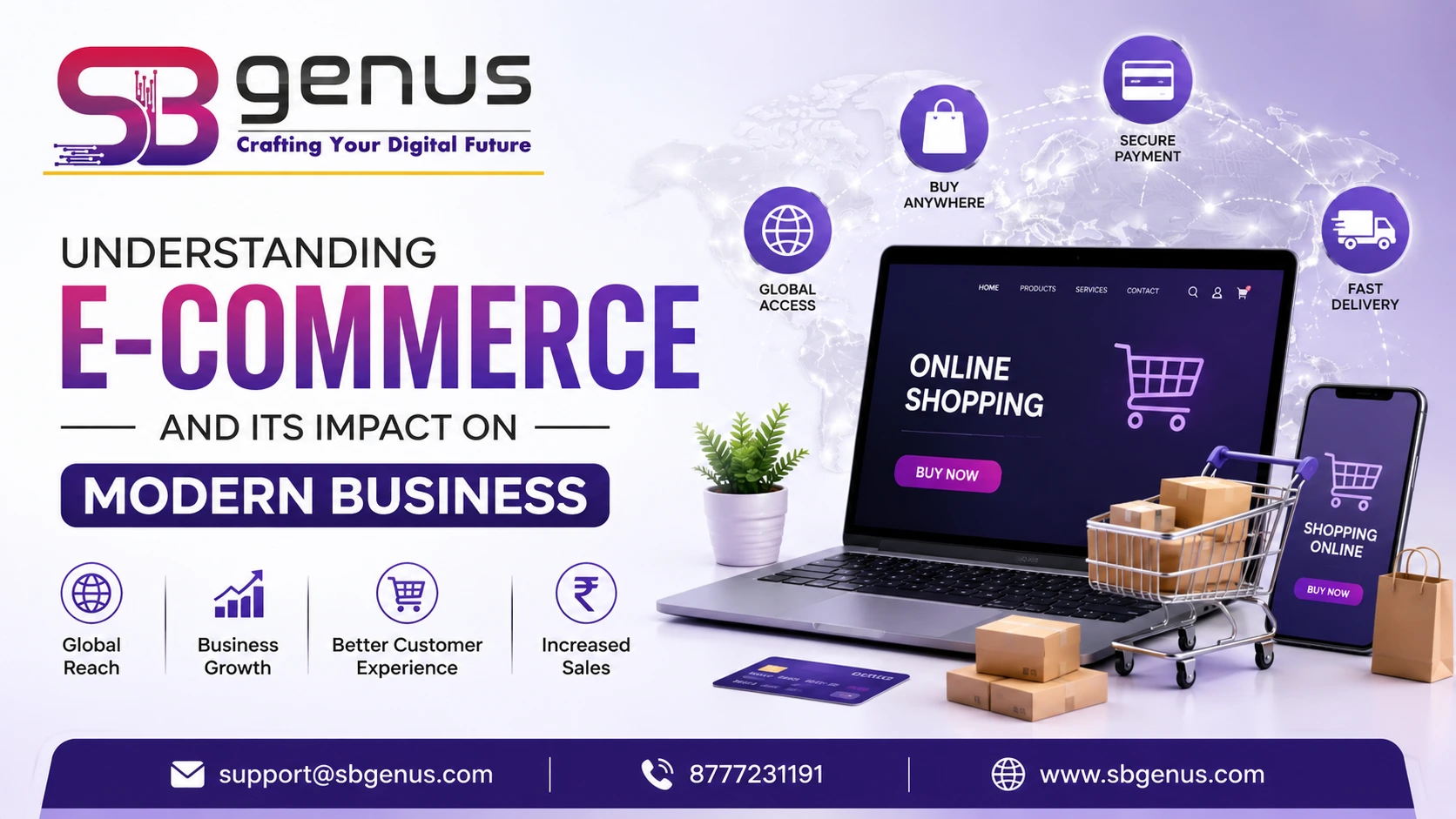
The digital revolution has transformed the way people communicate, work, shop, and conduct business. Among the most significant developments of this transformation is the rapid growth of e-commerce. Businesses of every size, from local startups to multinational corporations, are embracing online commerce to reach customers beyond geographical boundaries and provide convenient shopping experiences. The increasing availability of smartphones, affordable internet connectivity, secure payment systems, and advanced logistics networks has accelerated the adoption of e-commerce worldwide.
Consumers today expect businesses to be accessible around the clock, offering products and services with just a few clicks. This shift in consumer behaviour has encouraged organisations to rethink traditional business models and invest in digital platforms that enable seamless online transactions. Whether selling physical goods, digital products, subscriptions, or services, e-commerce has become an essential component of modern business strategy.
As competition continues to intensify across industries, businesses that effectively utilise e-commerce gain significant advantages in customer reach, operational efficiency, and revenue generation. Understanding how e-commerce works and its impact on businesses is therefore crucial for entrepreneurs, business owners, marketers, and consumers alike.
E-commerce, or electronic commerce, refers to the buying and selling of products or services through digital platforms over the internet. Unlike conventional retail stores that require customers to visit physical locations, e-commerce enables transactions to occur online at any time and from virtually anywhere.
An e-commerce business typically involves several integrated components, including an online storefront, product catalogues, shopping carts, secure payment gateways, inventory management systems, and logistics services. Together, these elements create a seamless shopping experience that allows customers to browse products, compare prices, place orders, make payments, and receive deliveries efficiently.
Modern e-commerce extends far beyond retail shopping. Businesses also conduct online transactions involving digital services, software subscriptions, online education, financial services, travel bookings, and business procurement. As technology continues to evolve, artificial intelligence, automation, cloud computing, and data analytics further enhance the capabilities of e-commerce platforms, making online business more efficient and customer-centric.
E-commerce has evolved significantly since the early days of the internet. During the 1990s, online shopping was limited due to slow internet connections, limited consumer trust, and basic website functionality. However, technological improvements gradually increased confidence in online transactions and encouraged businesses to expand their digital presence.
The introduction of secure payment systems, SSL encryption, and reliable banking integrations helped establish trust between buyers and sellers. Over time, improved website design, mobile applications, faster internet speeds, and advanced logistics transformed e-commerce into a mainstream business model.
The rise of smartphones further accelerated online shopping by enabling customers to browse and purchase products from virtually any location. Social media platforms also became influential sales channels, allowing businesses to engage directly with potential customers through targeted advertising and personalised marketing campaigns.
Today, cloud computing, machine learning, artificial intelligence, and automation have taken e-commerce to an entirely new level. Businesses can analyse customer behaviour, recommend personalised products, automate customer support through chatbots, and optimise inventory management using real-time data.
E-commerce encompasses several business models that serve different markets and customer groups. Business-to-Consumer (B2C) is the most common model, where businesses sell products or services directly to individual customers through online stores. This model includes online retailers offering fashion, electronics, groceries, furniture, cosmetics, and countless other products.
Business-to-Business (B2B) e-commerce involves transactions between companies. Manufacturers, wholesalers, distributors, and service providers use digital platforms to purchase raw materials, office supplies, software solutions, and industrial equipment. B2B platforms often involve larger transaction volumes and long-term business relationships.
Consumer-to-Consumer (C2C) platforms enable individuals to sell products or services directly to other consumers. These marketplaces allow users to list second-hand goods, handmade products, collectibles, or personal services while facilitating secure transactions between buyers and sellers.
Consumer-to-Business (C2B) is another growing model where individuals provide products or services to businesses. Freelancers, photographers, designers, influencers, consultants, and content creators often participate in C2B transactions by offering their expertise to companies seeking specialised skills.
Each of these models demonstrates the flexibility of e-commerce and its ability to support various commercial activities across industries.
E-commerce has fundamentally changed the way businesses operate by removing many of the limitations associated with traditional commerce. Companies are no longer restricted by geographical boundaries or limited operating hours. An online store can attract customers from different cities, states, or even countries without requiring physical expansion.
Digital commerce also enables businesses to gather valuable customer data that helps improve products, services, and marketing strategies. By analysing browsing behaviour, purchasing history, and customer preferences, businesses can create personalised shopping experiences that increase customer satisfaction and loyalty.
Marketing has also become more targeted through digital advertising, email campaigns, search engine optimisation, and social media engagement. Businesses can reach specific audiences based on demographics, interests, purchasing behaviour, and online activity, resulting in more efficient advertising expenditure and improved conversion rates.
Automation has significantly improved operational efficiency within e-commerce businesses. Order processing, inventory updates, invoice generation, customer notifications, and shipping management can all be automated, reducing manual workload while improving accuracy.
Customer service has evolved through live chat, AI-powered chatbots, automated support systems, and self-service knowledge bases that provide instant assistance throughout the purchasing journey. This continuous availability enhances customer confidence and contributes to stronger brand relationships.
One of the greatest advantages of e-commerce is its ability to significantly reduce operational costs compared to traditional brick-and-mortar businesses. Without the need for multiple physical storefronts, businesses can allocate more resources towards product development, marketing, customer experience, and technological innovation.
E-commerce also provides businesses with greater scalability. As demand increases, online platforms can expand product offerings, process larger order volumes, and serve wider markets without proportionally increasing infrastructure costs. Cloud-based technologies further support business growth by providing flexible and scalable digital solutions.
Global market accessibility represents another major benefit. Small businesses can now compete internationally by selling products across borders using reliable shipping networks and secure online payment systems. This accessibility creates opportunities that were previously available only to large multinational organisations.
The availability of detailed analytics also enables data-driven decision-making. Businesses can monitor website traffic, customer demographics, sales performance, conversion rates, abandoned shopping carts, and purchasing trends. These insights help improve marketing effectiveness, optimise pricing strategies, and enhance customer experiences.
Consumers likewise benefit from greater convenience, broader product selections, competitive pricing, and the ability to compare multiple products before making purchasing decisions. Fast delivery services, flexible payment options, and simplified return policies have further increased consumer confidence in online shopping.
Despite its numerous advantages, e-commerce also presents several challenges that businesses must carefully address. Cybersecurity remains one of the most significant concerns, as online businesses handle sensitive customer information including payment details and personal data. Strong encryption, secure payment gateways, regular security updates, and compliance with data protection regulations are essential for maintaining customer trust.
Competition within the online marketplace has intensified considerably. Businesses compete not only with local companies but also with national and international retailers offering similar products. Success increasingly depends on delivering exceptional customer experiences, competitive pricing, efficient logistics, and strong brand differentiation.
Logistics and supply chain management present additional complexities. Delayed deliveries, inventory shortages, damaged goods, and rising transportation costs can negatively affect customer satisfaction and business reputation. Efficient warehouse management and reliable logistics partnerships are therefore critical to maintaining smooth operations.
Customer expectations continue to rise as consumers demand faster shipping, personalised experiences, responsive customer support, and seamless returns. Businesses must continually invest in technology, employee training, and operational improvements to meet these evolving expectations.
Maintaining visibility in search engine results and digital marketplaces also requires continuous effort. Search engine optimisation, content marketing, social media engagement, paid advertising, and reputation management have become integral components of successful e-commerce strategies.
The future of e-commerce is being shaped by continuous technological innovation. Artificial intelligence is becoming increasingly important in personalising shopping experiences through intelligent product recommendations, predictive search functionality, and automated customer support.
Voice commerce is gaining popularity as consumers use smart assistants to search for products, place orders, and manage shopping lists through voice commands. Businesses are adapting their digital platforms to accommodate these new purchasing behaviours.
Augmented reality and virtual reality technologies are improving online shopping by allowing customers to visualise products before purchasing them. Furniture retailers, fashion brands, and cosmetics companies increasingly use these technologies to enhance customer confidence and reduce product returns.
Mobile commerce continues to expand rapidly as smartphones become the primary device for online shopping. Businesses are prioritising responsive website design, mobile applications, simplified checkout processes, and digital wallet integrations to improve mobile user experiences.
Sustainability has also become an important focus for modern consumers. Many businesses are adopting environmentally responsible packaging, carbon-conscious delivery options, ethical sourcing practices, and sustainable manufacturing processes to meet growing consumer expectations.
Subscription-based commerce, social commerce, live shopping events, influencer marketing, and AI-driven customer engagement are expected to further reshape the future landscape of digital commerce, providing businesses with new opportunities to connect with customers and drive long-term growth.
E-commerce has become one of the most influential forces driving modern business transformation. By enabling organisations to reach wider audiences, improve operational efficiency, personalise customer experiences, and operate beyond traditional geographical limitations, online commerce has fundamentally changed the global business environment.
While challenges such as cybersecurity, intense competition, logistics, and changing customer expectations continue to evolve, businesses that embrace innovation and invest in digital capabilities are well-positioned for long-term success. Technologies such as artificial intelligence, mobile commerce, augmented reality, automation, and advanced analytics will continue to redefine the future of online business.
For organisations seeking sustainable growth in an increasingly digital world, adopting an effective e-commerce strategy is no longer optional—it has become an essential requirement. Businesses that prioritise customer experience, technological innovation, operational excellence, and data-driven decision-making will remain competitive and resilient in the rapidly evolving digital economy. As consumer preferences continue to shift towards online interactions, e-commerce will undoubtedly remain at the centre of business growth and global commercial development for years to come.
Trusted Clients



.jpg)


.jpg)
.jpg)








SB Genus is a Kolkata-based tech company specializing in custom web development, app development, digital marketing, and startup growth.


© 2017-2026 SB Genus. All rights reserved.