SB Genus
 04 Aug 2026
The Importance of Backend Development in Modern Web Applications
04 Aug 2026
The Importance of Backend Development in Modern Web Applications


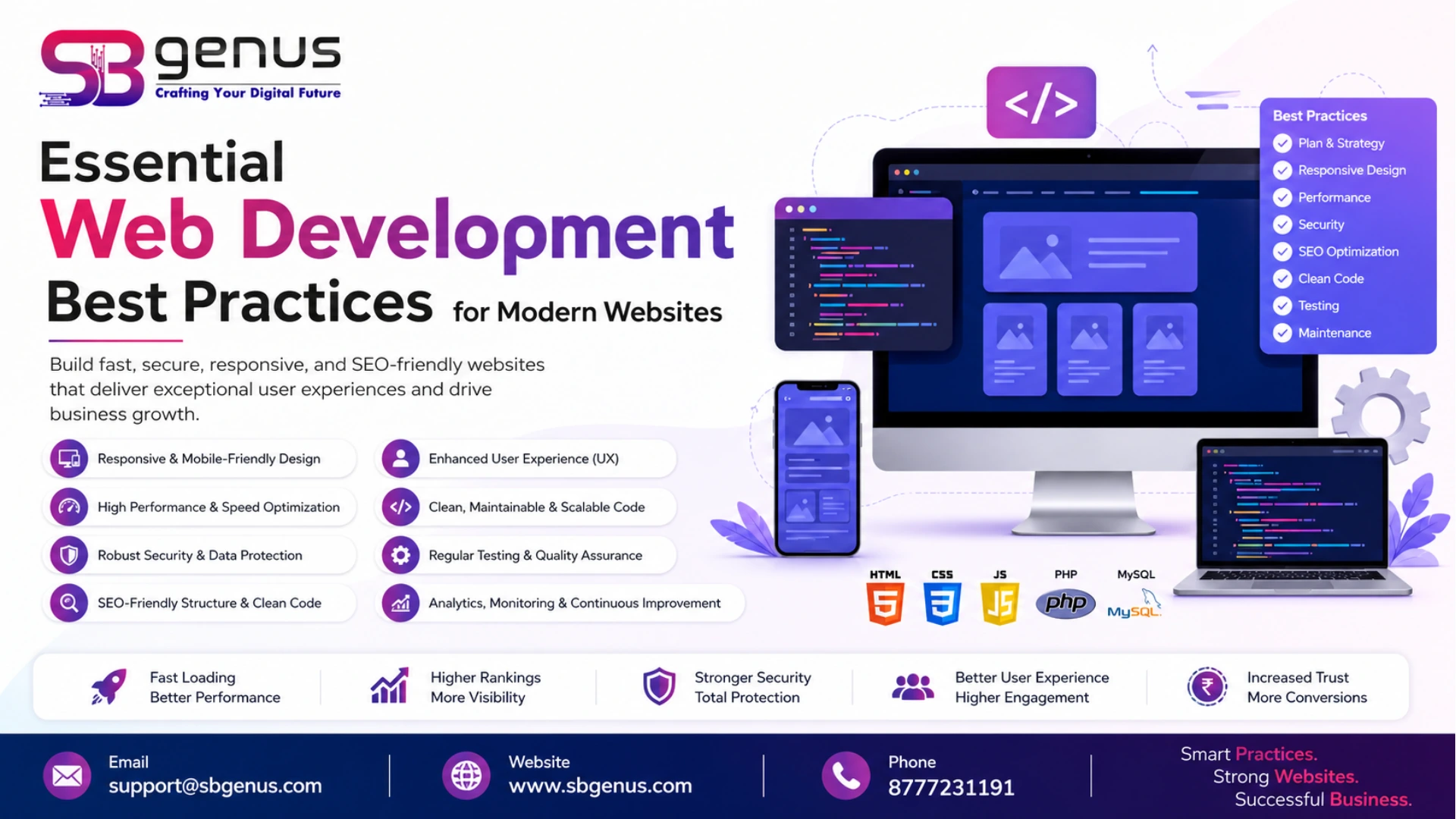
In today's digital landscape, a website is much more than an online presence—it's a powerful business tool that influences customer trust, engagement, and conversions. Whether you're developing a business website, an eCommerce platform, or a web application, following modern web development best practices ensures your project performs efficiently, remains secure, and delivers an exceptional user experience.
As technologies continue to evolve, developers must focus not only on writing functional code but also on creating websites that are fast, responsive, scalable, secure, and search engine friendly.
Modern web development is no longer just about creating visually appealing websites. Users expect websites to load quickly, work seamlessly across devices, protect their personal information, and provide an intuitive browsing experience.
Search engines like Google also reward websites that follow technical best practices, making web development an essential part of SEO and digital marketing success.
By implementing the following best practices, businesses can improve website performance, increase customer satisfaction, boost search rankings, and reduce long-term maintenance costs.
This comprehensive guide explores the top web development best practices that can significantly enhance your projects and help you build websites that stand out in today's competitive online marketplace.
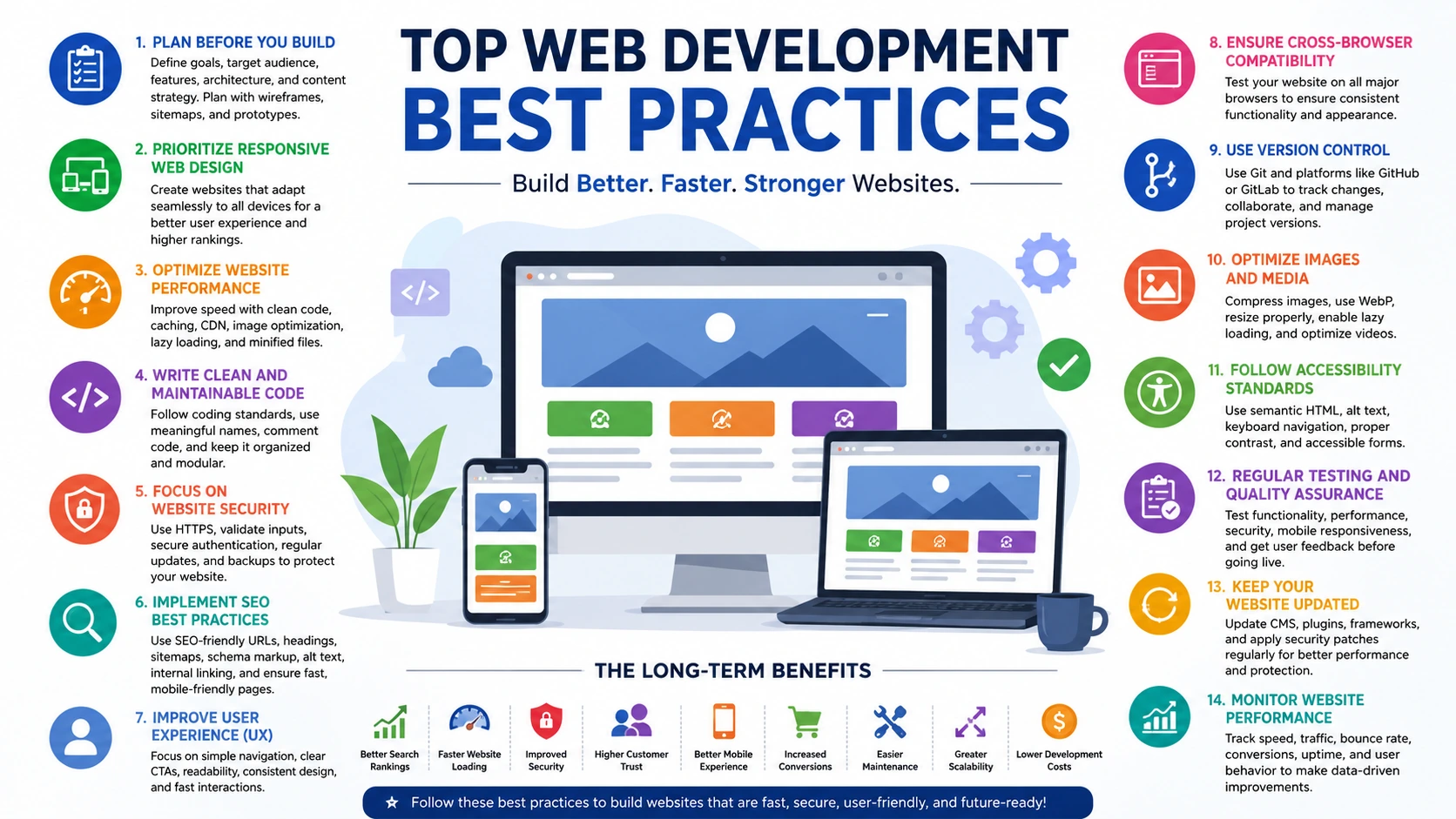
Every successful web development project starts with a well-defined strategy. Before writing any code, take time to create a comprehensive project roadmap that outlines your business goals, target audience, required functionalities, website architecture, user journey, and content strategy. Proper planning helps developers avoid costly mistakes, improve workflow efficiency, and ensure the final website meets both user expectations and business objectives. Creating wireframes, sitemaps, and interactive prototypes also simplifies the development process, improves team collaboration, and reduces the need for major revisions later.
Responsive web design is one of the most important web development best practices because users access websites from desktops, tablets, and smartphones. A responsive website automatically adjusts its layout, images, and content to provide an optimal viewing experience on every screen size. Google also prioritizes mobile-friendly websites in its search rankings, making responsive design essential for SEO. By using modern CSS frameworks such as Bootstrap, CSS Grid, and Flexbox, developers can build websites that deliver consistent performance, improved usability, lower bounce rates, and higher conversion rates across all devices.
Website performance plays a critical role in user experience, search engine optimization, and conversion rates. Slow-loading websites often lead to higher bounce rates and lower customer satisfaction. To improve website speed, developers should compress CSS and JavaScript files, minify HTML, enable browser caching, optimize database queries, reduce HTTP requests, implement lazy loading for images, and use a Content Delivery Network (CDN). A fast and optimized website not only enhances the browsing experience but also improves Core Web Vitals, helping achieve better rankings on search engines like Google.
Writing clean, organized, and maintainable code is essential for building scalable and high-performing websites. Well-structured code improves readability, simplifies debugging, and makes future updates more efficient. Developers should follow established coding standards, use meaningful variable and function names, separate HTML, CSS, and JavaScript into modular files, document complex logic with comments, and remove redundant or unused code. A clean codebase minimizes errors, enhances team collaboration, and reduces long-term maintenance costs for web development projects.
Website security should be a top priority throughout the web development lifecycle. Cyber threats continue to evolve, making it essential to protect both user data and business information. Start by implementing HTTPS with a valid SSL certificate to encrypt data transmitted between users and the server. Always validate and sanitize user inputs to prevent security vulnerabilities such as SQL Injection, Cross-Site Scripting (XSS), and Command Injection attacks. Strengthen authentication by enforcing strong password policies, enabling Multi-Factor Authentication (MFA), and using secure session management techniques. Regular automated backups, software updates, and security monitoring further safeguard your website from data loss and cyberattacks.
Technical SEO is a fundamental aspect of modern web development because it helps search engines crawl, index, and rank your website more effectively. Developers should create SEO-friendly URLs, maintain a proper heading hierarchy (H1–H6), generate XML sitemaps, configure robots.txt files, implement structured data using Schema Markup, and use canonical tags to prevent duplicate content issues. Additionally, optimizing image ALT attributes, improving internal linking, enhancing page speed, and ensuring mobile responsiveness significantly boost search engine visibility. Following these SEO best practices improves organic traffic and helps websites achieve higher rankings on search engine results pages (SERPs).
A positive user experience (UX) is essential for increasing visitor engagement, reducing bounce rates, and improving conversion rates. An intuitive website should feature clear navigation menus, consistent layouts, readable typography, strategically placed Call-To-Action buttons, and sufficient white space for better readability. Organizing content logically and ensuring fast page interactions allows users to find information quickly and complete desired actions with ease. Prioritizing user experience not only enhances customer satisfaction but also contributes to stronger SEO performance and long-term business success.
Users access websites through different browsers and operating systems, making cross-browser compatibility an essential web development best practice. A professionally developed website should function consistently on popular browsers such as Google Chrome, Mozilla Firefox, Microsoft Edge, Safari, and Opera. Developers should perform comprehensive browser testing to identify rendering issues, layout inconsistencies, or JavaScript compatibility problems. Using standardized HTML, CSS, and JavaScript ensures a seamless browsing experience regardless of the user's preferred browser.
Version control systems are indispensable tools for modern web development teams. Platforms such as Git, GitHub, and GitLab enable developers to track code changes, collaborate efficiently, manage multiple development branches, and restore previous versions when necessary. Implementing version control improves project organization, reduces deployment risks, simplifies debugging, and supports continuous development. Whether working individually or within a team, version control helps maintain code quality throughout the entire software development lifecycle.
Images and multimedia files significantly influence website loading speed and overall performance. Optimizing visual content is crucial for improving user experience and technical SEO. Developers should compress images without sacrificing quality, use modern image formats such as WebP, resize media to appropriate dimensions, implement lazy loading, and optimize videos for faster streaming. Proper media optimization reduces page load times, improves Core Web Vitals, conserves bandwidth, and enhances search engine rankings while delivering visually appealing content to users.
Building accessible websites ensures that people of all abilities can interact with your content effectively. Following accessibility standards not only supports inclusivity but also contributes to improved SEO and user experience. Developers should use semantic HTML elements, provide descriptive alternative text for images, ensure keyboard navigation support, maintain sufficient color contrast, create accessible forms, and optimize compatibility with screen readers. An accessible website reaches a broader audience while complying with modern web standards and accessibility guidelines.
Comprehensive testing and quality assurance are essential for delivering a reliable, secure, and high-performing website. Before deployment, developers should conduct functional testing to verify that every feature operates correctly, performance testing to evaluate website speed under varying traffic conditions, security testing to identify vulnerabilities, mobile testing across different devices, and User Acceptance Testing (UAT) to gather real-world feedback. Continuous testing throughout the development process helps identify issues early, minimizes bugs, and ensures a seamless user experience after launch.
A successful website requires ongoing maintenance even after deployment. Regularly updating your Content Management System (CMS), plugins, frameworks, libraries, and server software ensures compatibility with modern technologies and protects against emerging security threats. Applying security patches, fixing bugs, optimizing databases, and improving performance help maintain website stability and reliability. Routine maintenance extends the lifespan of your website while delivering consistent performance to users and search engines alike.
Web development does not end once a website goes live. Continuous website monitoring helps identify performance issues, user behavior patterns, and opportunities for improvement. Developers should regularly track important metrics such as page speed, Core Web Vitals, bounce rate, conversion rate, server uptime, traffic sources, and visitor engagement. Leveraging analytics and performance monitoring tools enables businesses to make data-driven decisions, improve user experience, optimize SEO performance, and ensure long-term digital success.
Implementing modern web development best practices is essential for building high-performing, secure, and user-friendly websites that deliver long-term business success. Whether you're developing a corporate website, an eCommerce platform, or a custom web application, following industry-standard development techniques helps improve website functionality, enhance user experience, and increase visibility in search engine results.
By adopting these proven web development strategies, businesses can enjoy numerous long-term benefits, including:
Stronger Brand Credibility and Customer Trust: A professional, secure, and high-performing website builds confidence among visitors and establishes your business as a reliable and trustworthy brand.
Ultimately, following these web development best practices not only enhances website performance, security, and SEO but also creates a strong foundation for sustainable online growth. Businesses that prioritize modern web development standards are better equipped to attract more organic traffic, improve customer engagement, increase conversions, and maintain a competitive advantage in today's rapidly evolving digital landscape.
Successful web development involves much more than writing code. It requires thoughtful planning, performance optimization, security, accessibility, responsive design, and continuous improvement. By adopting these best practices, developers and businesses can create websites that deliver exceptional user experiences while meeting modern technical standards.
Whether you're building a simple business website or a complex web application, following these principles will help ensure your project remains reliable, scalable, and competitive. Investing time in clean development practices today will save significant effort in maintenance, improve search engine rankings, and provide lasting value for your users and your business.
Ultimately, great websites are built with both users and search engines in mind. By making quality a priority at every stage of development, you create a digital experience that drives engagement, builds trust, and supports long-term success.
Web development best practices are industry-standard techniques and guidelines used to build websites that are fast, secure, responsive, accessible, and easy to maintain. These practices help improve website performance, user experience, search engine rankings, and long-term scalability.
Following web development best practices ensures your website delivers a better user experience, loads quickly, remains secure against cyber threats, and performs well in search engine results. They also reduce maintenance costs and improve the overall reliability of your website.
Responsive web design ensures your website adapts seamlessly to desktops, tablets, and smartphones. Since Google uses mobile-first indexing, a mobile-friendly website improves user experience, reduces bounce rates, and contributes to higher search engine rankings.
Website performance is influenced by page load speed, image optimization, browser caching, code quality, server response time, Content Delivery Networks (CDNs), database optimization, and minimizing HTTP requests. Optimizing these factors results in a faster and more efficient website.
You can improve website security by installing an SSL certificate (HTTPS), validating user inputs, preventing SQL Injection and Cross-Site Scripting (XSS) attacks, enabling Multi-Factor Authentication (MFA), keeping your software updated, and performing regular backups.
Technical SEO refers to optimizing the technical aspects of a website to help search engines crawl, index, and rank its pages effectively. This includes creating SEO-friendly URLs, XML sitemaps, structured data (Schema Markup), canonical tags, mobile optimization, and improving website speed.
Clean and well-structured code improves website performance, simplifies debugging, enhances collaboration among developers, and makes future updates easier. It also reduces technical debt and lowers long-term maintenance costs.
Cross-browser compatibility ensures that a website functions correctly across different web browsers such as Google Chrome, Mozilla Firefox, Microsoft Edge, Safari, and Opera. This provides a consistent user experience regardless of the browser visitors use.
Version control systems such as Git help developers track code changes, collaborate efficiently, restore previous versions, manage multiple branches, and reduce deployment errors. They are essential for modern web development workflows.
Optimizing images by compressing files, using modern formats like WebP, resizing images appropriately, and enabling lazy loading reduces page load time, improves Core Web Vitals, enhances user experience, and supports better SEO performance.
Website accessibility ensures that people with disabilities can use and navigate your website effectively. Following accessibility standards, such as using semantic HTML, alternative text for images, and keyboard-friendly navigation, improves usability while supporting SEO and legal compliance.
A website should be updated regularly by applying CMS updates, plugin upgrades, security patches, framework updates, and bug fixes. Routine maintenance helps improve security, performance, compatibility, and search engine visibility.
Popular website performance monitoring tools include Google PageSpeed Insights, Google Search Console, Google Analytics 4 (GA4), Lighthouse, GTmetrix, Pingdom, and WebPageTest. These tools help identify performance issues and optimization opportunities.
Modern web development best practices help businesses create fast, secure, and SEO-friendly websites that attract more organic traffic, improve customer engagement, increase conversions, strengthen brand credibility, and support long-term digital growth.
Beginners should focus on planning their projects, creating responsive designs, optimizing website speed, writing clean code, implementing website security, following technical SEO guidelines, ensuring accessibility, testing thoroughly, using version control, and maintaining their websites regularly.
Trusted Clients



.jpg)


.jpg)
.jpg)








SB Genus is a Kolkata-based tech company specializing in custom web development, app development, digital marketing, and startup growth.


© 2017-2026 SB Genus. All rights reserved.