

 SB Genus
 14 Oct 2026
Understanding Custom Web Application Development for Your Business Needs
14 Oct 2026
Understanding Custom Web Application Development for Your Business Needs


Software has become an essential part of almost every business and industry. From banking and healthcare to education, e-commerce and entertainment, organizations depend on software applications to perform daily operations, serve customers and improve efficiency. However, developing successful software is not simply a matter of writing code. It requires proper planning, clear requirements, careful design, testing, deployment and continuous maintenance.
The Software Development Life Cycle, commonly known as SDLC, provides a structured approach to software development. It defines the activities that need to be completed during the development of a software product, starting from the initial idea and continuing through maintenance and improvement. By following an organized development process, software teams can reduce risks, control costs, improve quality and deliver products that meet business and user requirements.
Software Development Life Cycle is a systematic process used by software development teams to plan, develop, test, deploy and maintain software applications. It provides a framework that helps developers, project managers, designers, testers and clients work toward a common objective.
The main purpose of SDLC is to ensure that software is developed in a controlled and organized manner. It helps teams understand what needs to be built, how it should be built, how its quality will be evaluated and how it will be maintained after release.
An SDLC generally begins when an organization identifies a business problem or software requirement. The requirement is then analyzed, a development plan is prepared, the software is designed and developed, and the finished product is tested before being released to users. After deployment, the software continues to be monitored, maintained and improved.
Although different organizations may use different SDLC methodologies, the fundamental objective remains the same: to develop reliable, secure, scalable and useful software while making efficient use of time and resources.
A structured development life cycle is important because software projects can become complicated when there is no clearly defined process. Without proper planning and requirement analysis, developers may build features that users do not need or misunderstand the actual business requirements. Such mistakes can result in increased development costs, project delays and poor user satisfaction.
SDLC provides a clear structure for the entire development process. It allows project teams to identify requirements at an early stage, estimate resources, define responsibilities and establish development timelines. It also provides opportunities to identify and resolve problems before they become expensive to fix.
Another important advantage of SDLC is improved software quality. Testing and quality assurance are incorporated into the development process rather than being treated as an afterthought. This helps teams identify defects, security issues and performance problems before the software reaches its users.
SDLC also improves communication between stakeholders. Clients, developers, designers, testers and managers can understand what is expected at each stage of the project. This creates greater transparency and makes it easier to measure project progress.
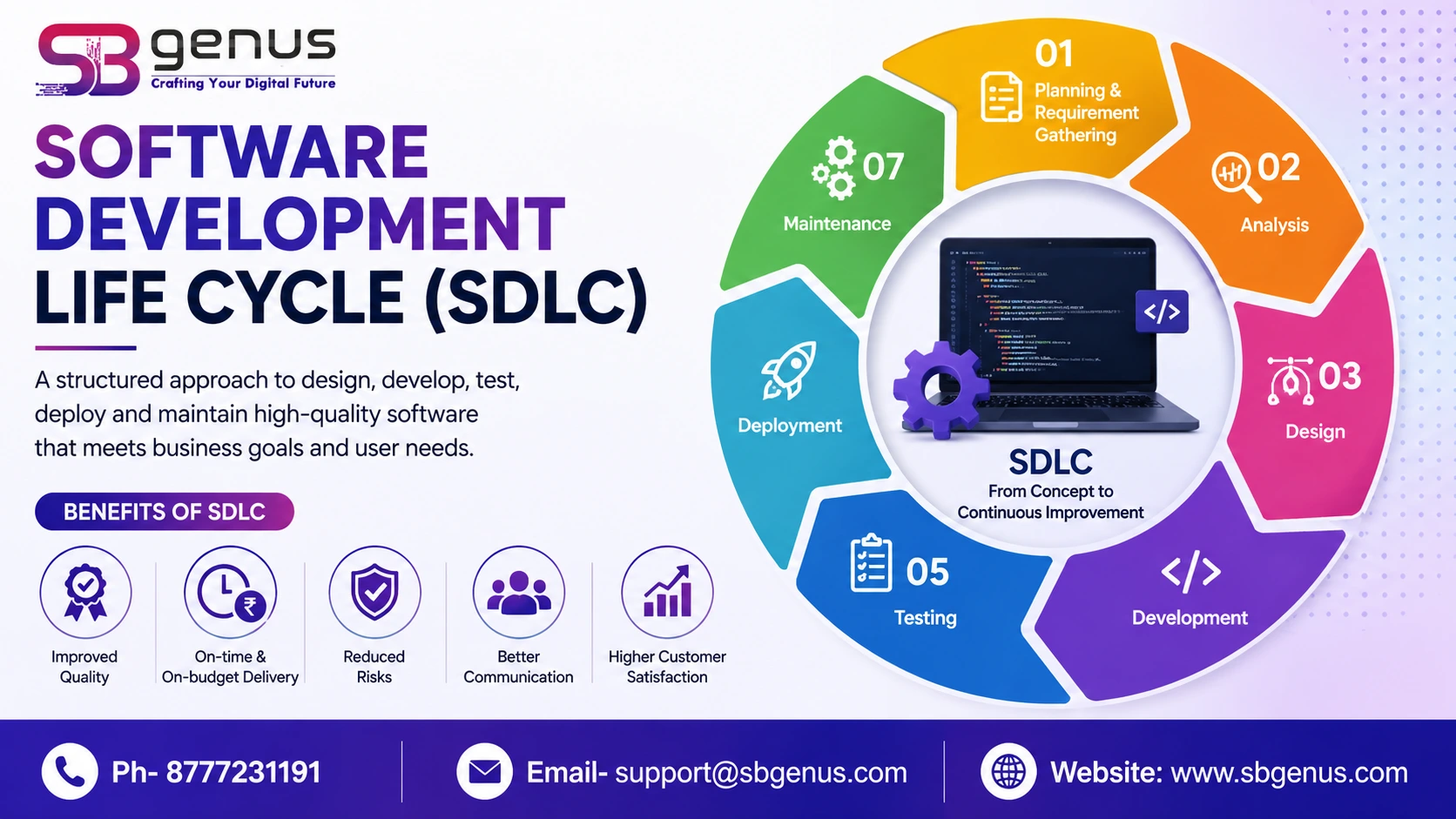
The Software Development Life Cycle generally consists of several interconnected phases. While the names and number of phases can vary depending on the methodology, the fundamental activities remain similar.
The first phase is planning and requirement gathering. At this stage, the development team works with stakeholders to understand the purpose of the software and identify the problems it is expected to solve. Functional and non-functional requirements are gathered, business objectives are discussed and the overall project scope is defined. Technical feasibility, budget, resources and expected timelines may also be considered. Proper requirement gathering is extremely important because errors at this stage can affect the entire project.
The next phase is system analysis. During analysis, the collected requirements are examined in greater detail. The team evaluates how the proposed system should work, what technologies may be required and what potential challenges could arise. Business processes, data requirements, security considerations and system limitations are also analyzed. The outcome of this phase provides a clearer understanding of the software that needs to be developed.
After analysis, the project moves into the design phase. Software architects, UI/UX designers and developers determine how the system will be structured. This may include designing the database, application architecture, user interface, navigation, APIs and other technical components. The design acts as a blueprint for development and helps ensure that different parts of the application can work together effectively.
The development phase is where the actual software is created. Developers write code based on the approved requirements and system design. Depending on the project, different programming languages, frameworks, databases and development tools may be used. Developers may work on different modules simultaneously and integrate them into a complete application. Following coding standards, version control practices and security principles during this stage can significantly improve the maintainability and reliability of the software.
Once development is completed, the software enters the testing phase. Testing is performed to determine whether the application works as expected and meets the defined requirements. Software testers may conduct functional testing, performance testing, security testing, usability testing, integration testing and other forms of quality assurance. Bugs and defects identified during testing are reported to developers for correction. Testing may continue through multiple development cycles until the software reaches an acceptable level of quality.
After successful testing, the software is deployed. Deployment means making the application available in its intended environment, such as a production server, cloud platform, mobile application store or internal business system. Depending on the nature of the project, deployment may happen all at once or gradually through techniques such as phased releases.
The final major phase is maintenance. Software development does not necessarily end when an application is launched. Users may identify new issues, business requirements may change and technology may evolve. Maintenance involves fixing bugs, improving performance, updating security, adding new features and ensuring compatibility with changing environments. Continuous maintenance helps software remain useful and secure over time.
Different SDLC models are used depending on project requirements, organizational practices and development environments. The Waterfall model is one of the traditional approaches. In this model, development progresses through predefined stages in a relatively sequential manner. Each phase is generally completed before the next phase begins. Waterfall can be suitable when requirements are stable and clearly understood from the beginning.
The Agile model takes a more flexible approach. Software is developed in smaller iterations, allowing teams to respond to changing requirements and incorporate user feedback throughout the project. Agile methodologies such as Scrum and Kanban are widely used in modern software development because they encourage collaboration, continuous improvement and frequent delivery.
The Spiral model combines iterative development with a strong focus on risk analysis. It is particularly useful for large or complex projects where identifying and managing risks is critical. Another approach is the V-Model, which places strong emphasis on testing and validation by associating testing activities with corresponding development stages.
The choice of SDLC model depends on factors such as project complexity, budget, timeline, requirement stability, risk level and customer expectations. There is no single model that is ideal for every software project.
Following an appropriate Software Development Life Cycle can provide significant benefits to organizations. One of the most important benefits is better project planning. Teams can understand the scope of work, required resources and expected timelines before development progresses too far.
SDLC can also reduce development risks by encouraging early identification of technical, financial and operational challenges. Since requirements and designs are evaluated before major development work begins, costly mistakes can often be prevented.
Another major benefit is improved software quality. A structured process ensures that testing, review and quality assurance receive appropriate attention. It can also improve security because security requirements can be considered during planning, design, development and testing rather than only after the software has been completed.
SDLC improves communication and collaboration as well. When responsibilities, requirements and deliverables are clearly defined, different members of a development team can work more effectively. Documentation created during the process can also help future developers understand how the system works.
Ultimately, SDLC helps organizations deliver software that is more reliable, maintainable and aligned with business objectives. It provides a foundation for managing both small applications and large enterprise software projects.
The Software Development Life Cycle is an essential framework for developing high-quality software in a systematic and organized way. It covers the complete journey of a software product, from planning and requirement gathering to design, development, testing, deployment and ongoing maintenance.
A successful software project requires more than technical programming skills. It requires clear requirements, effective communication, appropriate planning, careful design, thorough testing and continuous improvement. SDLC brings these activities together into a structured process and helps organizations reduce risks, control costs and deliver better software.
As technology continues to evolve, software development methodologies will continue to change. However, the fundamental principles of understanding requirements, designing carefully, developing systematically, testing thoroughly and maintaining continuously will remain important. By adopting an SDLC approach that matches their project requirements, organizations can improve development efficiency and build software that delivers long-term value to both businesses and users.
Software Development Life Cycle (SDLC) is a structured process used to plan, design, develop, test, deploy and maintain software. It helps development teams create software systematically while managing quality, cost, time and project risks.
SDLC provides a clear framework for managing a software project from beginning to end. It helps teams understand requirements, identify risks, manage resources, improve software quality and ensure that the final product meets business and user expectations.
The main phases generally include planning and requirement gathering, analysis, system design, development, testing, deployment and maintenance. The exact phases can vary depending on the SDLC methodology used by the organization.
During requirement gathering, the development team communicates with clients, users and other stakeholders to understand what the software needs to accomplish. Functional requirements, business objectives, user expectations and technical requirements are identified and documented.
System design creates the technical blueprint for the software. It defines aspects such as application architecture, database structure, user interface, system components, APIs and technology choices. Developers use this design as a guide during implementation.
During development, programmers write and integrate the source code based on the approved requirements and system design. Different modules and features are developed and combined to create the complete software application.
Software testing helps identify bugs, security vulnerabilities, performance problems and functional issues before the software is released. It ensures that the application behaves as expected and meets the defined requirements.
Deployment is the process of releasing the completed and tested software into its intended environment. This may involve launching a website on a production server, releasing a mobile application or implementing software within an organization's infrastructure.
Software maintenance involves supporting and improving an application after deployment. It can include fixing bugs, improving performance, addressing security issues, updating compatibility and introducing new features based on changing requirements.
Common SDLC models include Waterfall, Agile, Spiral and V-Model. Each model follows a different approach to planning, development, testing and project management, so organizations select a model based on their project requirements and circumstances.
Waterfall generally follows a sequential development process where phases are completed in a planned order. Agile uses iterative development, allowing teams to deliver software in smaller increments and adapt to changing requirements throughout the project.
Yes. SDLC principles can be applied to projects of different sizes. For a small project, the process may be simpler and require less documentation, while a large enterprise project may require extensive planning, documentation, testing and risk management.
SDLC can reduce costs by identifying requirements, technical issues and risks early in the project. Proper planning and testing can prevent expensive rework, while structured development practices can improve resource utilization and reduce project delays.
Different professionals can participate in SDLC depending on the project. These may include project managers, business analysts, UI/UX designers, software developers, database specialists, quality assurance testers, security professionals, DevOps engineers and clients or other stakeholders.
There is no single SDLC model that is best for every project. The appropriate model depends on factors such as project size, complexity, budget, timeline, risk level and how frequently requirements are expected to change. Agile is often suitable for projects with evolving requirements, while Waterfall may work well when requirements are stable and clearly defined.
Trusted Clients



.jpg)

.jpg)
.jpg)

















.png)

SB Genus is a Kolkata-based tech company specializing in custom web development, app development, digital marketing, and startup growth.


© 2017-2026 SB Genus. All rights reserved.

.png)
.jpeg)


