

 SB Genus
 21 Aug 2026
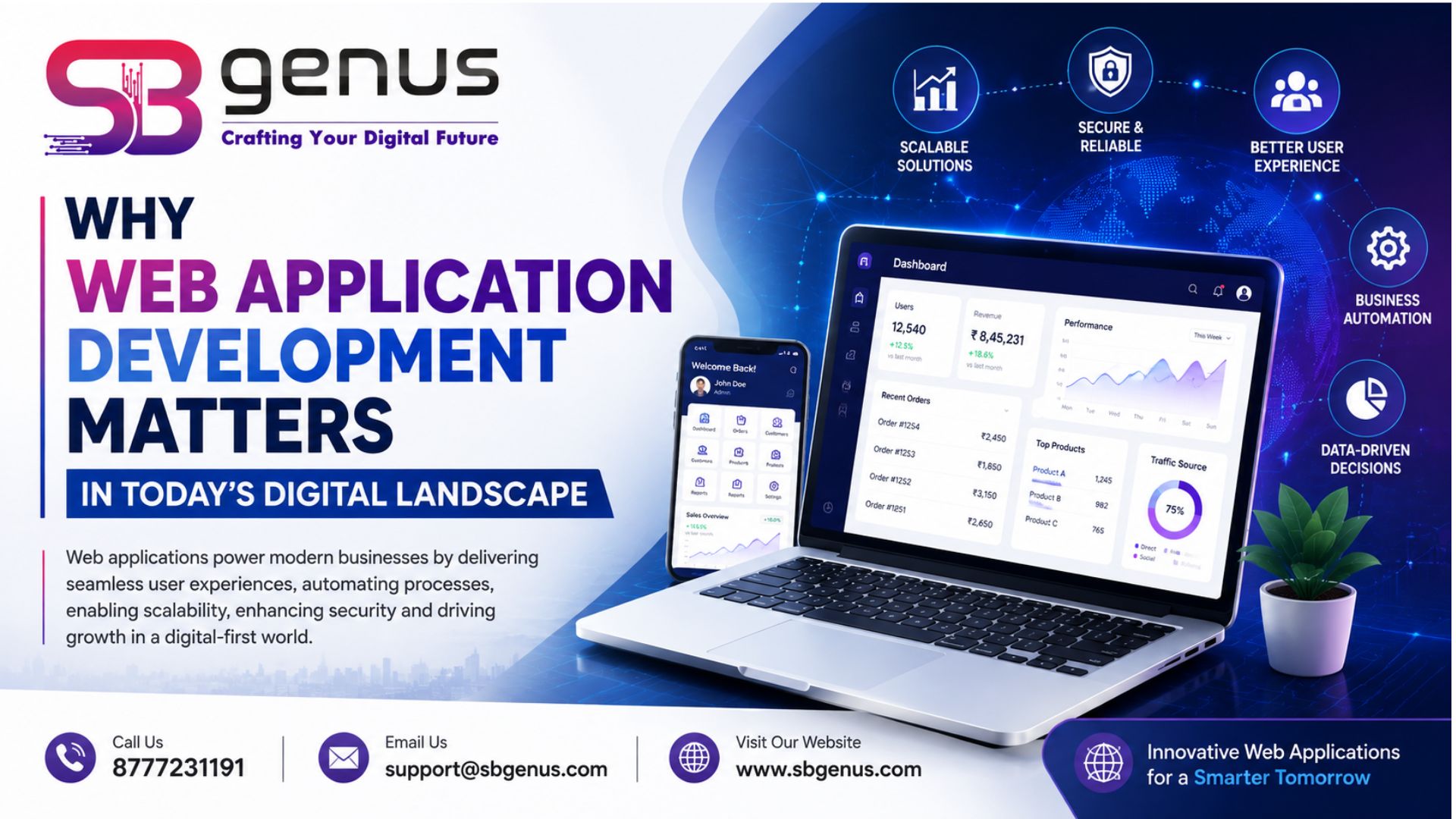
Why Web Application Development Matters in Today’s Digital Landscape


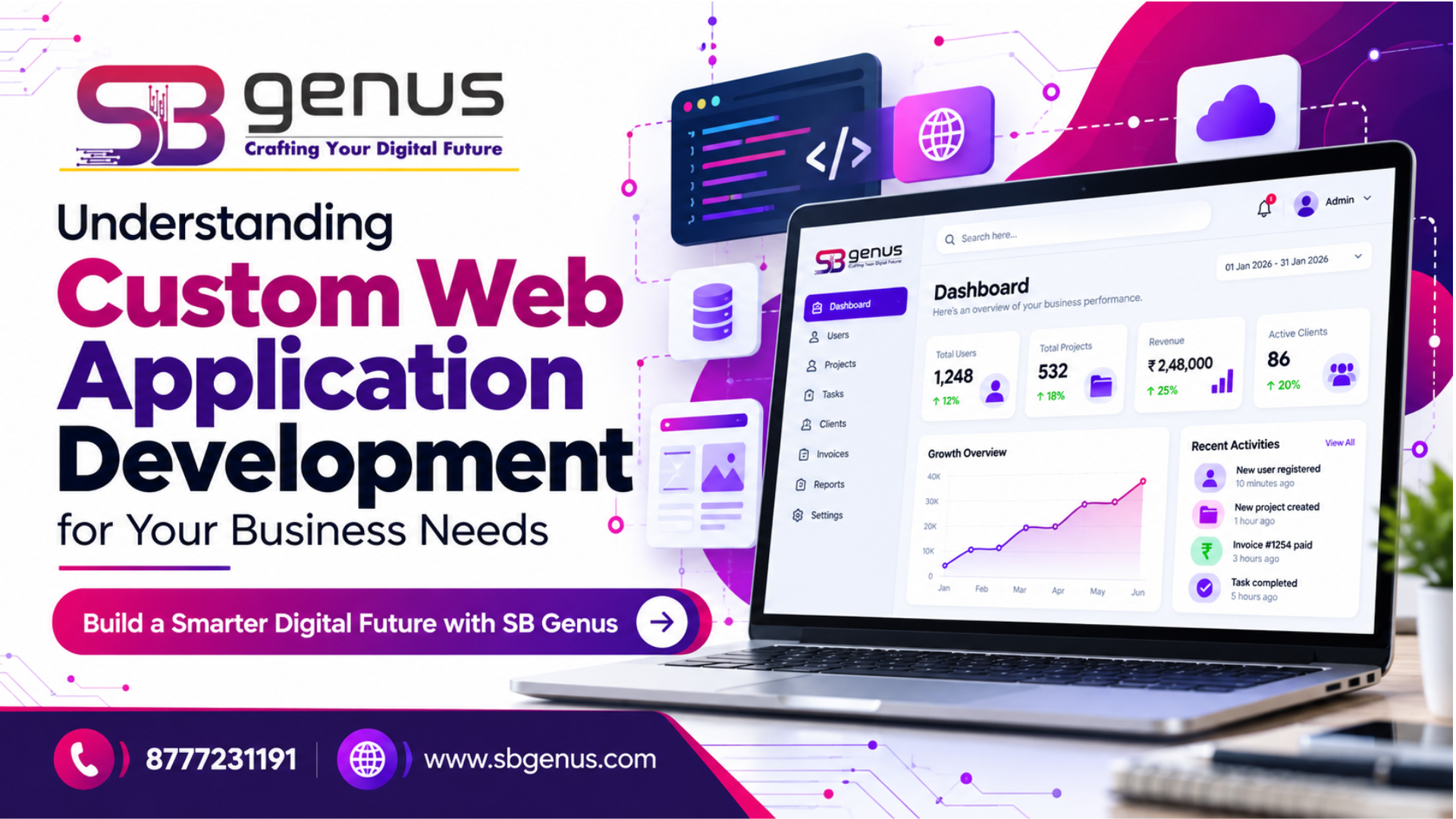
In today's competitive digital landscape, businesses need more than just a website to operate efficiently and achieve sustainable growth. They need intelligent digital solutions that simplify daily operations, automate repetitive tasks, improve customer experiences, and support long-term business objectives. Custom web application development has become an essential part of this digital transformation.
Whether you run a startup, small business, educational institution, e-commerce company, or established enterprise, a custom web application can help you manage your operations more effectively. From customer relationship management and billing software to inventory management systems and comprehensive business management platforms, customized applications can be designed to address your specific requirements.
At SB Genus, we understand that every business has unique challenges and operational needs. Our approach to web application development focuses on creating practical, scalable, and user-friendly digital solutions that align with business goals. Rather than relying entirely on generic software, businesses can invest in applications designed around their workflows, customers, and growth strategies.
In this article, we will explore custom web application development, its benefits, the development process, technology considerations, and how the right development partner can help your business achieve its digital objectives.
Custom web application development is the process of designing, developing, testing, and maintaining browser-based software specifically tailored to an organization's requirements. Unlike a traditional informational website, a web application enables users to perform interactive tasks, manage information, process transactions, and access business services online.
Examples include customer relationship management systems, billing applications, employee management software, inventory management platforms, online booking systems, educational portals, and e-commerce management applications.
A custom application is built around the organization's operational processes and desired outcomes. It can include specific user roles, automated workflows, customized dashboards, reporting tools, and integrations with existing software.
For example, an educational institution may need an application that combines student admissions, attendance tracking, fee collection, examination management, and online learning resources. A retail business may require centralized inventory, order processing, billing, and customer management.
SB Genus helps businesses explore customized digital solutions that address these practical challenges and support more efficient operations.
As businesses grow, managing operations through spreadsheets, disconnected software, and manual processes can become increasingly difficult. Information may be duplicated, employees may spend unnecessary time completing repetitive tasks, and management may struggle to obtain accurate reports.
A custom web application can bring important business activities into a centralized platform. It can automate processes such as invoice generation, payment tracking, appointment scheduling, stock updates, and customer notifications. This reduces manual effort and helps employees concentrate on higher-value responsibilities.
Custom applications can also improve customer satisfaction by providing convenient access to services. Customers may be able to place orders, track requests, make payments, download invoices, or manage their accounts without contacting the business for every transaction.
Another advantage is improved decision-making. Centralized data and customized reports can help business owners understand sales performance, customer activity, inventory levels, and operational efficiency.
For organizations with specialized workflows, custom development also provides flexibility. New features can be introduced as requirements change, allowing the application to evolve alongside the business.
Ready-made software is developed for a broad audience and usually offers standardized features. It can be a suitable choice when a business has common requirements and wants to start quickly.
Custom web applications are designed around specific business needs, giving organizations greater control over functionality, user experience, integrations, and future enhancements.
For example, a small retailer may find a standard billing application sufficient for everyday transactions. However, a growing business with multiple branches, customized pricing, centralized inventory, and specialized reporting may need a more tailored solution.
The investment also differs. Ready-made software may involve subscription fees, licensing costs, and additional charges for premium features. Custom development generally requires a higher initial investment but can provide greater flexibility for specialized workflows.
The right choice depends on your budget, business size, operational complexity, and long-term goals. SB Genus can help you evaluate your requirements and identify a suitable development approach.
A well-designed web application includes features that directly support business operations. Secure login systems and role-based access controls allow administrators, employees, customers, and managers to access the functions relevant to them.
Customized dashboards provide an overview of important activities, including sales, pending payments, customer inquiries, inventory, and performance indicators. Database management capabilities allow businesses to store, organize, search, and update information efficiently.
Third-party integrations can connect applications with payment gateways, accounting platforms, email services, SMS providers, shipping services, and other business tools. These integrations help reduce duplicate data entry and streamline workflows.
Responsive design ensures that the application works across desktops, laptops, tablets, and smartphones. Security features, including encrypted communication, input validation, secure authentication, and regular updates, help protect sensitive information.
At SB Genus, the objective is to identify the features that provide genuine business value and develop a solution that is practical, user-friendly, and aligned with your operational requirements.
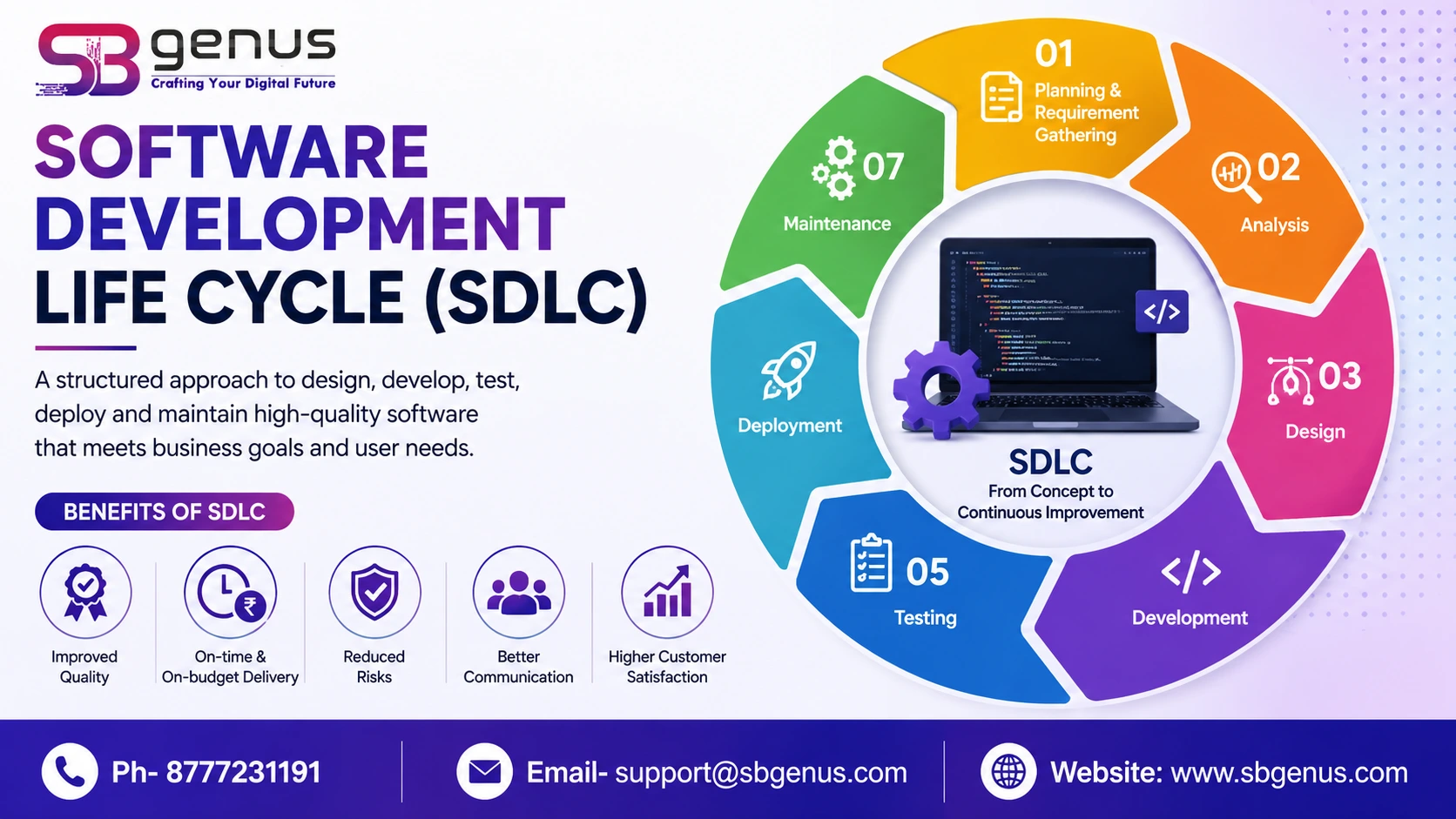
Successful development begins with requirement analysis. The development team studies the business model, target users, workflows, required features, budget, and expected outcomes. This creates a clear foundation for planning the application.
The next stage involves designing the user interface and application architecture. Wireframes and interface designs help establish how users will navigate the platform, while technical planning determines how the frontend, backend, database, and integrations will work together.
During development, the frontend provides the interface users interact with, while the backend handles business logic, authentication, data processing, and communication with databases or external services.
Testing is essential before launch. Functional testing verifies that features work correctly, security testing identifies vulnerabilities, and performance testing evaluates the application's reliability under expected workloads.
After successful testing, the application is deployed to an appropriate hosting or cloud environment. Deployment may include domain configuration, SSL installation, database migration, backup setup, and administrator training.
Ongoing maintenance keeps the application secure, reliable, and compatible with evolving business requirements. This may involve software updates, bug fixes, performance improvements, and additional features.
A structured development process helps reduce uncertainty and ensures that the final application is designed to solve the problems identified at the beginning of the project.
The technology stack influences an application's performance, security, scalability, and maintainability. The right combination depends on the project's complexity, expected usage, integrations, and long-term objectives.
Frontend technologies such as HTML, CSS, JavaScript, React, and Vue.js can be used to create responsive and interactive interfaces. Backend technologies such as PHP, Laravel, Node.js, and Python support business logic, APIs, authentication, and data processing.
Database systems such as MySQL and PostgreSQL help store and manage business information. Suitable hosting infrastructure, version control, monitoring tools, and testing frameworks also contribute to application reliability.
Security must be considered throughout the technology selection process. Supported software versions, secure configurations, regular updates, appropriate access controls, and tested backups are essential for protecting business data.
SB Genus can recommend a practical technology stack based on your specific requirements rather than choosing technologies solely because they are popular. The goal is to create a maintainable solution that meets present needs while allowing future expansion.
Custom web application development can improve operational efficiency by automating repetitive tasks and reducing dependence on manual processes. Businesses can centralize information, simplify workflows, and improve consistency across departments.
Customization allows organizations to implement features that directly support their business models. This reduces unnecessary steps and creates a more convenient experience for employees and customers.
Scalability is another important benefit. As a company grows, additional users, modules, integrations, and reporting capabilities can be introduced according to changing requirements.
Custom applications can also improve data visibility by providing centralized dashboards and reports. When information is organized and accessible to authorized users, management can make more informed decisions.
Furthermore, businesses can create differentiated digital experiences that support customer retention and competitive advantage.
With the right planning and implementation partner, a custom web application can become a valuable business asset that supports productivity, customer satisfaction, and long-term growth.
Custom development can face challenges when requirements are unclear or project expectations are unrealistic. Changes introduced late in development may increase costs and delay delivery.
A detailed scope of work, prioritized feature list, agreed milestones, and regular progress reviews can help minimize these risks.
Budget planning should include development, testing, hosting, security, third-party integrations, training, and maintenance. Focusing exclusively on the initial development cost may result in unexpected expenses later.
Security is another important consideration. Weak authentication, outdated software, and insufficient access controls can expose sensitive information. Secure coding practices, testing, regular updates, and monitoring help reduce these risks.
Performance problems can arise when applications are not designed for their expected workloads. Database optimization, suitable infrastructure, caching, and load testing can improve reliability.
Employee adoption also matters. Clear documentation, training, and responsive support can help users become comfortable with the new system and realize its benefits.
Working with an experienced development partner and maintaining clear communication throughout the project can make these challenges easier to manage.
Choosing a web development partner is an important step because the quality of the application depends on technical expertise, communication, and a clear understanding of business objectives.
Review the provider's portfolio, development capabilities, experience with similar projects, and approach to testing and security. Ask how the team will handle future upgrades, integrations, backups, and ongoing maintenance.
Transparency is equally important. A professional proposal should explain the project scope, features, estimated timeline, payment terms, deliverables, and exclusions.
You should also clarify ownership of source code, design assets, documentation, and database structures. These details should be included in the development agreement.
Avoid choosing a provider based solely on the lowest quotation. A solution that is poorly planned or difficult to maintain may create additional costs in the future.
The right partner will understand your business challenges, recommend appropriate solutions, communicate clearly, and focus on delivering long-term value.
SB Genus is a web development and digital solutions company committed to helping businesses strengthen their digital presence and streamline their operations. We understand that technology should solve business problems, simplify everyday work, and create opportunities for growth.
Our services cover web development, custom software solutions, business applications, CRM systems, billing software, and other digital solutions designed around specific organizational requirements.
We believe that successful development begins with understanding the client's business. By identifying operational challenges and essential features, we can help establish a clear project scope and a practical development strategy.
Our approach emphasizes functionality, usability, responsive design, and maintainability. We aim to build solutions that support business processes while providing room for future improvements.
Whether you need a customer management platform, an inventory management system, a billing application, an educational management portal, or a more comprehensive business solution, SB Genus can help you explore the right approach for your requirements.
Learn more about our services at www.sbgenus.com and discover how the right digital solution can support your business objectives.
Custom web application development continues to evolve as businesses adopt cloud infrastructure, artificial intelligence, advanced automation, and connected digital services.
Artificial intelligence can support features such as customer service chatbots, intelligent search, document processing, and predictive analysis when these capabilities are appropriate for the business.
Cloud infrastructure can provide flexible resource allocation, while API-based architectures make it easier to connect applications with external services. Progressive web applications can also provide app-like experiences through supported web browsers.
Automation is becoming increasingly valuable because businesses can connect different activities and reduce repetitive manual work.
However, successful digital transformation requires more than adopting the latest technology. Businesses should evaluate each feature according to its practical value, implementation cost, security implications, and long-term maintenance requirements.
With a clear strategy and the right development partner, organizations can use modern web applications to improve efficiency and prepare for future opportunities.
Custom web application development enables businesses to move beyond manual processes and disconnected tools by creating digital solutions tailored to their unique requirements. From billing and inventory management to customer relationship management and enterprise workflows, the right application can improve productivity, simplify operations, and enhance customer experiences.
Achieving these results requires clear planning, appropriate technology, reliable security, effective testing, and ongoing maintenance. Selecting an experienced development partner can help ensure that the solution aligns with business objectives and provides long-term value.
SB Genus is ready to help you take the next step toward a more efficient and digitally empowered business. Whether you are planning a new web application or looking to improve an existing workflow, we can help you explore a solution designed around your goals.
Stop letting manual processes, disconnected tools, and outdated workflows slow your business down. Invest in a digital solution that works around your business requirements and grows with your ambitions.
Contact SB Genus today to discuss your project, explore the right features, and get a customized development proposal for your business.
Visit https://www.sbgenus.com/ to learn more about our web development and digital solutions services.
SB Genus — Your Partner in Web Development and Digital Transformation.
Custom web application development involves creating browser-based software tailored to a business's specific needs. It can include billing systems, CRM platforms, inventory management, reporting tools, and automated workflows.
A website primarily presents information, while a web application allows users to perform interactive tasks such as managing records, making payments, placing orders, and generating reports. However, modern websites can also include application-like features.
The cost depends on the application's complexity, features, integrations, security requirements, and timeline. SB Genus can help evaluate your requirements and prepare a customized quotation based on the agreed project scope.
A simple application may take several weeks, while a medium-sized or enterprise-level platform may require several months or longer. The timeline depends on functionality, integrations, testing, and project complexity.
Yes. Small businesses can benefit from customized applications for billing, customer management, inventory tracking, appointment scheduling, and other operational activities. Development can begin with essential features and expand over time.
Common technologies include HTML, CSS, JavaScript, React, PHP, Laravel, Node.js, Python, MySQL, and PostgreSQL. The appropriate stack depends on the application's technical and business requirements.
They can be designed with security measures such as secure authentication, role-based access, encrypted communication, input validation, and regular updates. Continuous maintenance and security testing remain essential.
Yes. Applications can integrate with payment gateways, accounting systems, email services, SMS platforms, shipping providers, and other services through APIs and supported connectors.
Yes. Responsive development allows users to access applications through smartphones, tablets, laptops, and desktops. Additional features can provide an app-like experience when required.
Custom software is developed or configured around specific organizational requirements, while SaaS software is typically delivered as a hosted subscription service. The appropriate choice depends on budget, customization needs, and operational complexity.
Ownership depends on the development agreement. Businesses should clearly establish their rights to source code, design assets, documentation, and other deliverables before development begins.
Yes. A well-planned application can be expanded with additional modules, integrations, user roles, reports, and automation features as business requirements evolve.
Maintenance may include security updates, bug fixes, performance optimization, database monitoring, backup verification, and feature enhancements to ensure continued reliability.
Custom development may be suitable if your business relies on repetitive manual processes, disconnected software, specialized workflows, or reporting requirements that existing tools cannot adequately address.
Visit www.sbgenus.com to explore our digital solutions services and contact SB Genus to discuss your business requirements. Share your objectives, essential features, and expected budget so that the project scope and development approach can be evaluated.
Trusted Clients



.jpg)

.jpg)
.jpg)



















SB Genus is a Kolkata-based tech company specializing in custom web development, app development, digital marketing, and startup growth.


© 2017-2026 SB Genus. All rights reserved.
.png)
.jpeg)


